Dining in China with a peanut allergy is not the time to be casual. Peanut oil is the lifeblood of many Chinese kitchens. It is used for frying, in sauces, and often mixed into cheaper vegetable oils without being explicitly labeled on the menu.
If you are traveling here, you need more than a vague “no peanuts, please” request. You need a system.
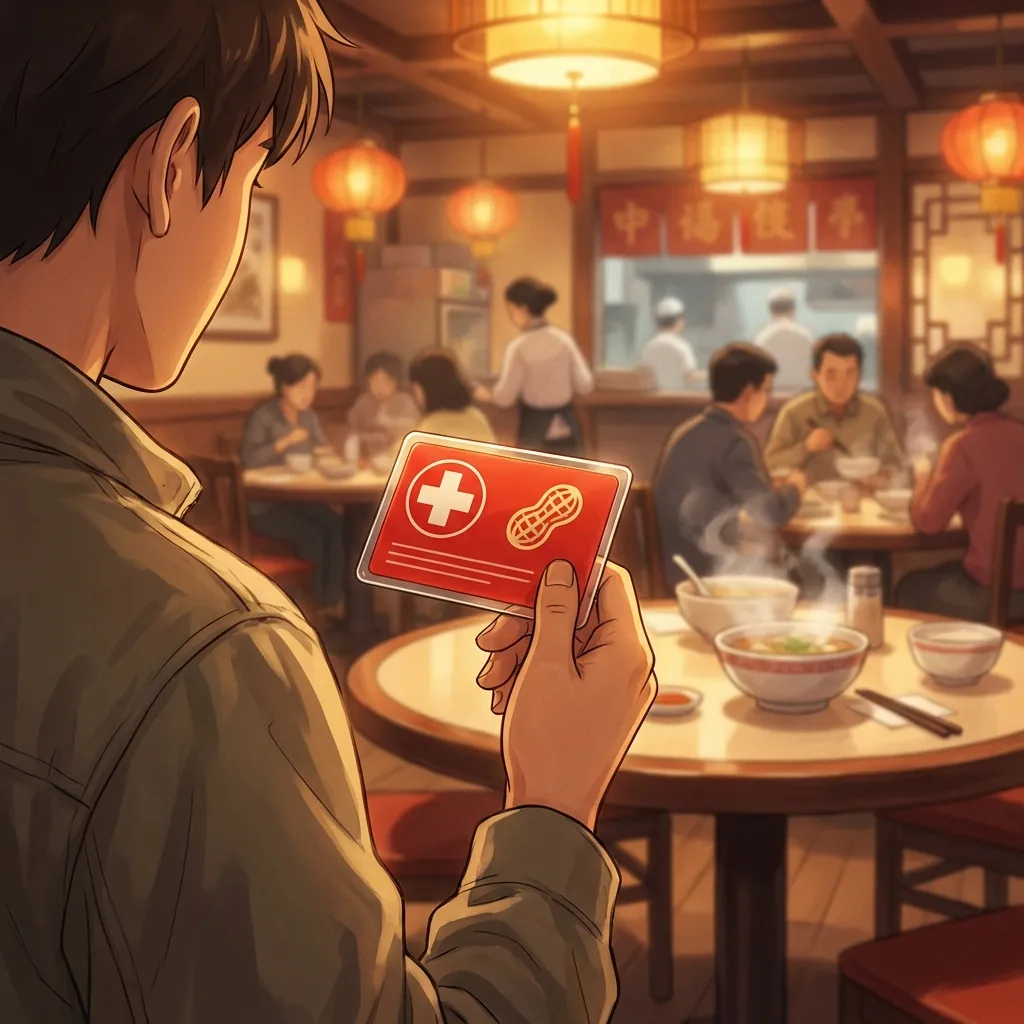
Most travelers make the mistake of having just one translation card. I recommend two distinct tools: a Chef Card (to prevent the poison) and a Medical Emergency Card (to handle the worst-case scenario).
This guide covers exactly how to build a peanut allergy translation card chinese speakers will actually understand, ensuring you stay safe while exploring the local cuisine.
The Life-Saving Distinction
When you are sitting in a restaurant, you are negotiating with the staff. You are using what I call the “Prevention Tool.” You are trying to avoid cross-contact and ensure your food is safe. This requires politeness but firmness.
However, if you accidentally ingest a peanut, the situation changes instantly. You are no longer a customer negotiating a meal; you are a patient needing rescue. The waiter doesn't need to know you don't like peanuts; the paramedic needs to know you are entering anaphylaxis and need epinephrine immediately.
Do not cram these two very different messages onto one small piece of paper. It confuses the reader. Separate them.
The Prevention Tool: Chef Cards
This card is for the waiter and the chef. It needs to address the specific way Chinese kitchens operate.
Simply saying “I am allergic to peanuts” is often interpreted as “I don't like whole peanuts on top of my Kung Pao Chicken.” You must explicitly mention peanut oil and cross-contamination.
Essential Vocabulary
| Simplified | Traditional | Pinyin | Meaning | Note |
|---|---|---|---|---|
| 花生 | 花生 | huā shēng | Peanut | The base enemy. |
| 花生油 | 花生油 | huā shēng yóu | Peanut oil | Extremely common in wok cooking. |
| 过敏 | 過敏 | guò mǐn | Allergy | Key medical term. |
| 有生命危险 | 有生命危險 | yǒu shēng mìng wēi xiǎn | Life-threatening | Literally "has life danger." |
| 严格 | 嚴格 | yán gé | Strict | Use this to emphasize severity. |
The Script
When you sit down, don't just hand over the card silently. Use the techniques from how to call the waiter to get their full attention first. Then present this text:
我对花生和花生油有严重的过敏。 (Wǒ duì huā shēng hé huā shēng yóu yǒu yán zhòng de guò mǐn.) I have a severe allergy to peanuts and peanut oil.
吃一点点也会有生命危险。 (Chī yī diǎn diǎn yě huì yǒu shēng mìng wēi xiǎn.) Eating even a tiny bit is life-threatening.
请确认这道菜不用花生油,也没有接触过花生。 (Qǐng què rèn zhè dào cài bù yòng huā shēng yóu, yě méi yǒu jiē chù guò huā shēng.) Please confirm this dish does not use peanut oil and has not touched peanuts.
Notice the grammar here. We aren't just asking “can I eat this?” (see hui vs neng vs keyi for why that's vague). We are stating a medical fact.
We also need to address the wok. Woks are often rinsed quickly between dishes. If the previous dish was Kung Pao Chicken, your “safe” vegetable stir-fry might kill you. This is why I wrote a dedicated guide on severe allergy flashcards, but for peanuts specifically, you must ask them to wash the wok.
请厨师把锅洗干净。 (Qǐng chú shī bǎ guō xǐ gān jìng.) Please ask the chef to wash the wok clean.
The Reaction Tool: Emergency Medical Cards
This is the card you hope you never use.
If you start feeling symptoms (tight throat, hives (urticaria), difficulty breathing), you might not be able to speak clearly. This card does the talking for you. It instructs bystanders or paramedics on what to do.
Keep this card in the same pocket as your EpiPen (auto-injector).
Critical Medical Data Fields
This card shouldn't say “please.” It uses imperative commands. It’s not about saving face; it’s about saving your life.
Front of Card (Large Text):
紧急情况!我有严重过敏反应! (Jǐn jí qíng kuàng! Wǒ yǒu yán zhòng guò mǐn fǎn yìng!) EMERGENCY! I am having a severe allergic reaction!
Instructions for the Helper:
请帮我注射肾上腺素 (EpiPen)。 (Qǐng bāng wǒ zhù shè shèn shàng xiàn sù.) Please help me inject epinephrine.
请立刻拨打 120 (急救电话)。 (Qǐng lì kè bō dǎ yāo èr líng.) Please call 120 (ambulance) immediately.
不要离开我。 (Bù yào lí kāi wǒ.) Do not leave me.
Note: In China, the emergency number is 120, not 911.
Vocabulary for the ER
If you are conscious enough to speak to the doctor, or if you are explaining a biphasic reaction (where symptoms return hours later), these words are vital.
| Simplified | Traditional | Pinyin | Meaning | Note |
|---|---|---|---|---|
| 肾上腺素 | 腎上腺素 | shèn shàng xiàn sù | Epinephrine | The drug in your EpiPen. |
| 呼吸困难 | 呼吸困難 | hū xī kùn nán | Breathing difficulty | A major symptom. |
| 救护车 | 救護車 | jiù hù chē | Ambulance | Dial 120. |
| 休克 | 休克 | xiū kè | Shock | Anaphylactic shock. |
Best Practices for Usage
1. The "Show, Don't Tell" Rule
Don't just wave the card. Wait for the waiter to look at you. Hand it to them with two hands (a sign of respect, but also ensures they take it physically). Ask them to show it to the chef.
请给厨师看。 (Qǐng gěi chú shī kàn.) Please show this to the chef.
2. Trust Your Instincts
If the waiter glances at the card for 0.5 seconds and says “méi wèn tí” (no problem) without checking with the kitchen, do not eat there. A quick “yes” is often a brush-off. See my post on how to say yes to understand the nuances of agreement; if they aren't taking it seriously, leave.
3. Carry Backups
Paper tears. Ink runs. Print five copies of your Peanut Allergy Emergency Card. Laminate them. Keep one in your wallet, one in your phone case, and one taped to your EpiPen case.
Travel in China is an amazing experience, and the food is a huge part of that. But safety comes first. With these tools, you can navigate the menus without fear.