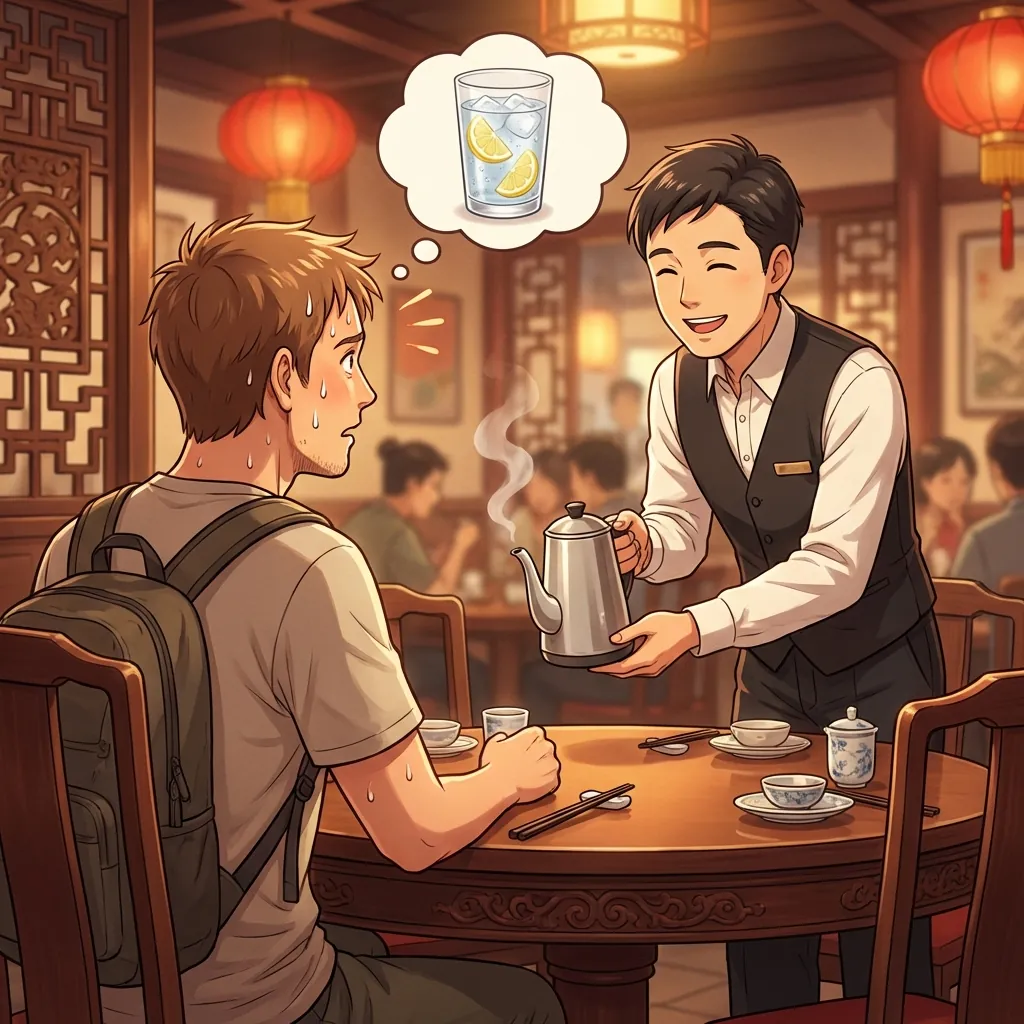
You have just walked ten blocks in the humid Shanghai summer. You sit down at a restaurant, sweating through your shirt, and ask for water. The waiter smiles, nods, and places a steaming kettle of boiling liquid in front of you.
This is the classic China expat initiation.
If you want to survive the summer without scalding your tongue, you need to understand how to ask for ice water in a Chinese restaurant no hot water default included. It is not as simple as translating the word "cold." You are fighting against thousands of years of medical tradition and a very practical fear of tap water.
Here is how to get the hydration you actually want.
The Vocabulary of Temperature
First, let’s look at the basic gradient of water temperature in China. If you don't specify, you get the first one on this list.
| Simplified | Traditional | Pinyin | Meaning | Note |
|---|---|---|---|---|
| 开水 | 開水 | kāi shuǐ | Boiled Water | The default. Usually served scalding hot. |
| 热水 | 熱水 | rè shuǐ | Hot Water | Often synonymous with Kai Shui. |
| 温水 | 溫水 | wēn shuǐ | Warm Water | Drinkable immediately, but not refreshing. |
| 常温 | 常溫 | cháng wēn | Room Temp | The compromise. Not hot, not cold. |
| 冰水 | 冰水 | bīng shuǐ | Ice Water | What you probably want. |
If you simply ask for 水 (shuǐ), you are getting hot water. No exceptions.
Why "Leng Shui" (Cold Water) Might Fail You
The direct translation for "cold water" is 冷水 (lěng shuǐ). However, I rarely recommend using this phrase in a local eatery.
Why? Because of the concept of Sheng Shui (Raw Water).
In China, tap water is not potable. It must be boiled to become safe. When you ask a waiter for "cold water," their internal logic chain often goes like this:
- Water must be boiled to be safe.
- Boiled water is hot.
- Therefore, cold water has not been boiled.
- Cold water is unsafe raw water (Sheng Shui).
Waiters often refuse to serve you "cold water" not because they are being difficult, but because they don't want you to get sick from drinking tap water. They assume you don't understand the hygiene risks.
The Strategy: How to Actually Get Cold Water
To bypass the "Raw Water" panic, you need to be specific about the source or the state of the water.
Method 1: The "Bing Shui" Direct Approach
If you want cold water, ask for Bing Shui (Ice Water). By specifying "Ice," you signal that you want a beverage, not just tap water.
-
You:
请给我一杯冰水。 Qǐng gěi wǒ yī bēi bīng shuǐ. Please give me a cup of ice water.
-
Waiter:
不好意思,没有冰水。 Bù hǎoyìsi, méiyǒu bīng shuǐ. Sorry, we don't have ice water.
If they say they don't have it (common in smaller, traditional places), move to Method 2.
Method 2: The "Ping Zhuang Shui" Cheat Code
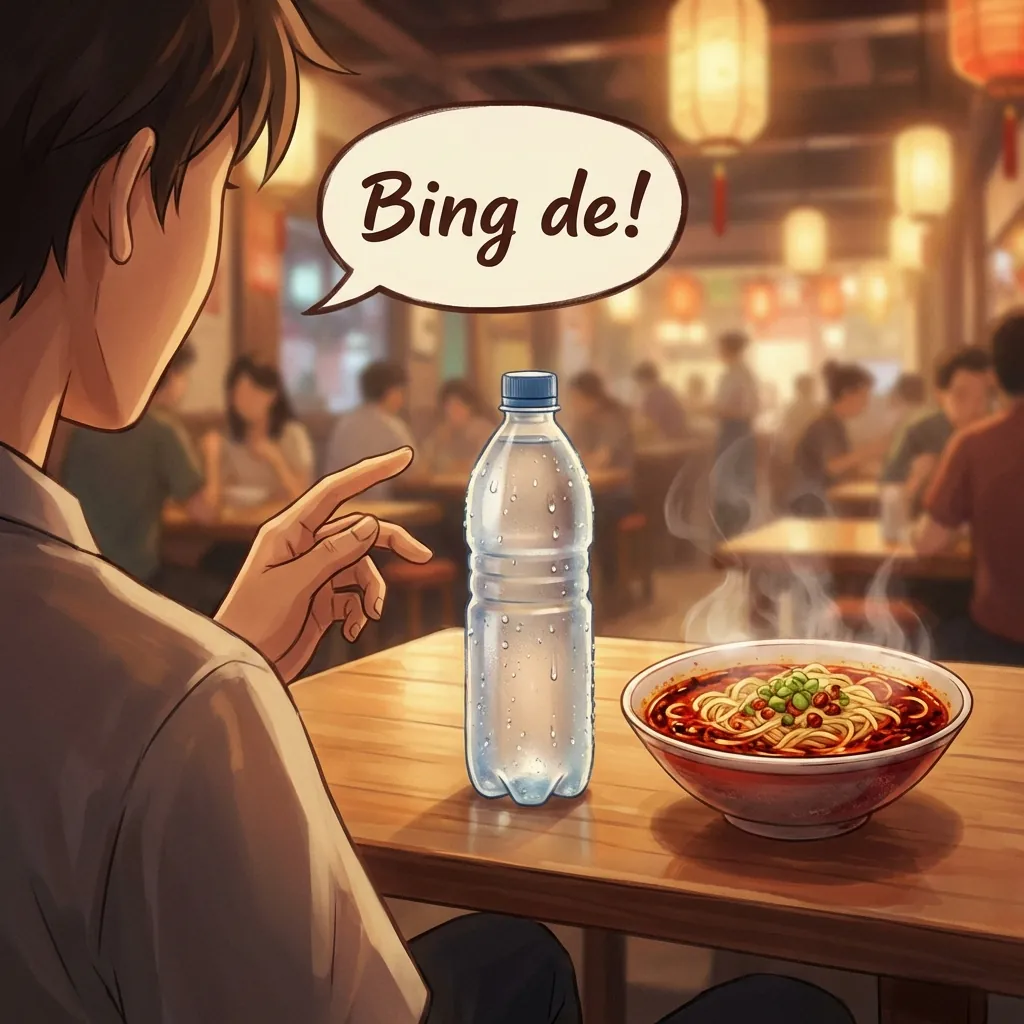
This is the most reliable method. If a restaurant doesn't have an ice machine, they almost certainly have a fridge full of drinks. You are asking for Ping Zhuang Shui (Bottled Water).
Because it comes from a sealed bottle, the waiter knows it is safe. Because it's in the fridge, it's cold. Everyone wins.
- You:
有冰的瓶装水吗? Yǒu bīng de píngzhuāng shuǐ ma? Do you have cold bottled water?
If you just say "bottled water," they might hand you a room-temperature bottle from a box under the counter. Make sure to add 冰的 (bīng de) or "cold/iced" to your request.
Method 3: The "Chang Wen" Compromise
If you are stuck in a place with no fridge and only a hot water kettle (it happens), your goal is damage control. You want to avoid the scalding hot water. You want Chang Wen (Room Temp).
This usually implies water that has been boiled previously and allowed to cool down, or bottled water that hasn't been refrigerated.
- You:
我要常温的,不要热的。 Wǒ yào chángwēn de, bùyào rè de. I want room temperature, not hot.
This is a useful phrase to pair with negation logic to ensure you don't get the kettle.
Cultural Context: Why They Might Protest
Sometimes, even when ice is available, an older waiter or a concerned ayi might hesitate. This comes from Traditional Chinese Medicine (TCM). In this view, cold water extinguishes the "digestive fire" needed to process your meal.
If they say:
喝冰水对胃不好。 Hē bīng shuǐ duì wèi bù hǎo. Drinking ice water is bad for the stomach.
You can smile and politely insist:
没关系,我习惯了。 Méiguānxi, wǒ xíguàn le. It's okay, I'm used to it.
Quick Takeaways
- Don't just say "Shui": You will get hot water.
- Avoid "Leng Shui": It sounds like you want dirty tap water.
- Use "Ping Zhuang Shui": Bottled water is your safety net for cold drinks.
- Check the Bubble Tea logic: If you are ordering sweet drinks, the ice level vocabulary applies here too.
Next time you see that steaming kettle heading your way, be ready with your "Bing Shui" defense.