You’ve just sat down at a restaurant in Chengdu. The air is spicy, your mouth is slightly numb, and you are incredibly thirsty. You wave the waiter over and ask for water.
He nods, leaves, and returns with a glass. You take a big gulp, expecting relief, and nearly burn your tongue. It’s boiling hot water.
Welcome to one of the most common culture shocks in China. If you are asking for cold water in a Chinese restaurant, you can't just say "water." You need to be specific about the temperature and the source.
Here is how to make sure you get exactly what you want.
The Safety Rule: Avoid the Tap
First, a safety briefing. In many Western countries, "tap water" is the default free option. In China, tap water, known as 自来水 (zìláishuǐ), is generally not potable directly from the faucet. It must be boiled first.
This is why the free water served in restaurants is almost always hot; it has been boiled to make it safe. If you want cold water, you usually need to buy a bottle.
Core Vocabulary: The Water Menu
Before we build the sentence, you need the right bricks.
| Simplified | Traditional | Pinyin | Meaning | Note |
|---|---|---|---|---|
| 水 | 水 | shuǐ | Water | Generic. Usually implies hot water in a restaurant. |
| 矿泉水 | 礦泉水 | kuàngquánshuǐ | Mineral water | The standard word for bottled water. |
| 冰 | 冰 | bīng | Ice / Iced | The magic adjective you need. |
| 热 | 熱 | rè | Hot | The default state of liquids in China. |
| 常温 | 常溫 | chángwēn | Room temperature | Extremely common preference in China. |
The "Room Temperature" Trap
This is where beginners get tripped up. You might think, "Okay, I'll just order a bottle of water. Bottles are cold, right?"
Wrong.
In China, many people prefer drinking water at 常温 (chángwēn), or room temperature, even in the blistering summer heat. Restaurants often keep cases of water under the counter or on a shelf, not in the fridge.
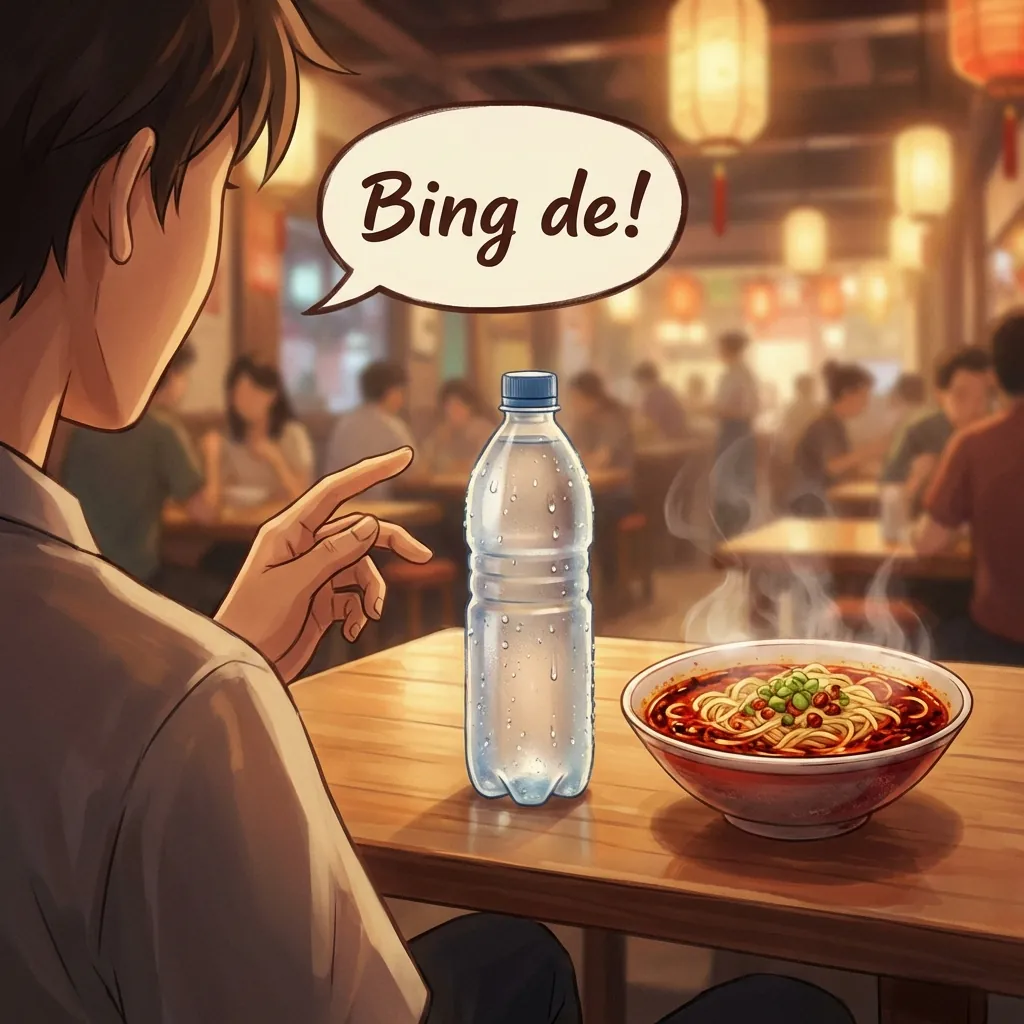
If you simply ask for 矿泉水 (kuàngquánshuǐ), the waiter will likely hand you a room-temperature bottle. To get it cold, you must add the modifier 冰的 (bīng de).
The Script: How to Order
When you are flagging down the staff (remember to check how to call the waiter politely), use this sentence structure.
The Direct Request
请给我一瓶冰的矿泉水。Pinyin: Qǐng gěi wǒ yī píng bīng de kuàngquánshuǐ. Meaning: Please give me one bottle of cold mineral water.
Let's break that down:
- Qǐng gěi wǒ (Please give me)
- Yī píng (One bottle)
- Bīng de (Cold/Iced one)
- Kuàngquánshuǐ (Mineral water)
If that feels like a mouthful, you can simplify it. Point to the menu or just look at the waiter and say:
我要冰水。Pinyin: Wǒ yào bīng shuǐ. Meaning: I want ice water.
The "Do you have it?" Check
Some smaller family-run spots might not keep their drinks in a fridge (to save electricity). It helps to ask first:
有没有冰的?Pinyin: Yǒu méiyǒu bīng de? Meaning: Do you have cold ones?
What if they say "Meiyou"?
If they tell you 没有 (don't have), it usually means they only have room temperature bottles. You have two backup plans.
Backup Plan A: Ask for Ice
This is hit-or-miss. Many traditional Chinese restaurants do not have ice machines because they don't serve iced drinks. But it is worth a try, especially in places serving beer or soda.
那有没有冰块?Pinyin: Nà yǒu méiyǒu bīngkuài? Meaning: Then do you have ice cubes?
Backup Plan B: Accept the "Changwen"
If you are eating very spicy food, like a Sichuan hotpot, room temperature water is actually safer for your stomach than hot water, even if it's not the icy refreshment you dreamed of.
常温的也可以。Pinyin: Chángwēn de yě kěyǐ. Meaning: Room temperature is also fine.
Summary
To survive the heat and the spice, remember this formula:
- Don't drink tap water.
- Default is hot. If you say nothing, you get hot water.
- Specify "Bing de". You must ask for "ice" to get it cold.
- Expect "Changwen". Room temperature is the standard for bottled drinks.
Stay hydrated, and maybe double-check that bottle cap is sealed before you drink.