One of the first things you notice in a noisy Beijing restaurant is that nobody is using two hands to count. In the West, if you want to signal the number "seven," you hold up five fingers on one hand and two on the other. In China, that is inefficient.
Chinese culture has perfected the art of counting to ten entirely on one hand. This is incredibly useful when you are carrying bags, holding a phone, or just want to be quick.
But for learners, it is confusing. You ask for two beers, and the waiter flashes a peace sign. Fine. You ask for six, and they give you a "hang loose" gesture. You ask for ten, and they threaten you with a fist.
Why a fist? And why does "eight" look like a gun? Here is the logic behind the chinese hand gestures for numbers 1-10 and why the number ten is a linguistic pun in disguise.
The Logic of 1-5: Universal Basics
Let's get the easy part out of the way. Numbers 1 through 5 are exactly what you expect, with one minor stylistic variation.
- 1: Index finger up.
- 2: Index and middle finger up (Peace sign).
- 3: This varies. The standard is the "OK" sign fingers (middle, ring, pinky) up. However, many people just use the Western style (index, middle, ring).
- 4: Four fingers up (thumb tucked in).
- 5: All five fingers open.
If you stick to Western counting for 1-5, you will be understood perfectly. The chaos starts at six.
The Symbolic Shift: Numbers 6-9
From six onwards, the fingers no longer represent units (1 finger = 1 unit). They become symbolic shapes.
6 (Six): The 'Hang Loose'
Extend your thumb and pinky finger, folding the middle three fingers down. It looks exactly like the Hawaiian "shaka" or the gesture for "call me."
Why? It is believed to mimic the shape of the character 六 (liù), particularly the bottom strokes. Others suggest it relates to the phonetic similarity between numbers and other words, but visually, it is distinct.
7 (Seven): The 'Pinch'
Bring your thumb, index, and middle fingers together to touch at the tips. It looks like a bird beak or a pinch.
Depending on the region, you might also see the thumb and index finger touching (pointing down) while the other fingers are clenched. This mimics the shape of the character 七 (qī) turned upside down.
8 (Eight): The 'Gun'
Extend your thumb and index finger to form an 'L' shape. This is the gesture for 8, not 2.
This is the most dangerous one for Westerners. In the US, this is often "two" or a "gun." In China, this is strictly 八 (bā). The shape mimics the character 八 which consists of two lines sloping apart.
This gesture is vital because 8 is a lucky number associated with wealth. If you are bargaining in a market, throwing up this sign confidently can save you time.
9 (Nine): The 'Hook'
Curl your index finger into a hook shape (like a pirate's hook), with the other fingers closed.
This mimics the curve of the character 九 (jiǔ).
The Mystery of 10: Fist vs. Cross
Here is where dialects and regions split the logic.
The Northern Fist (The Stone Pun)
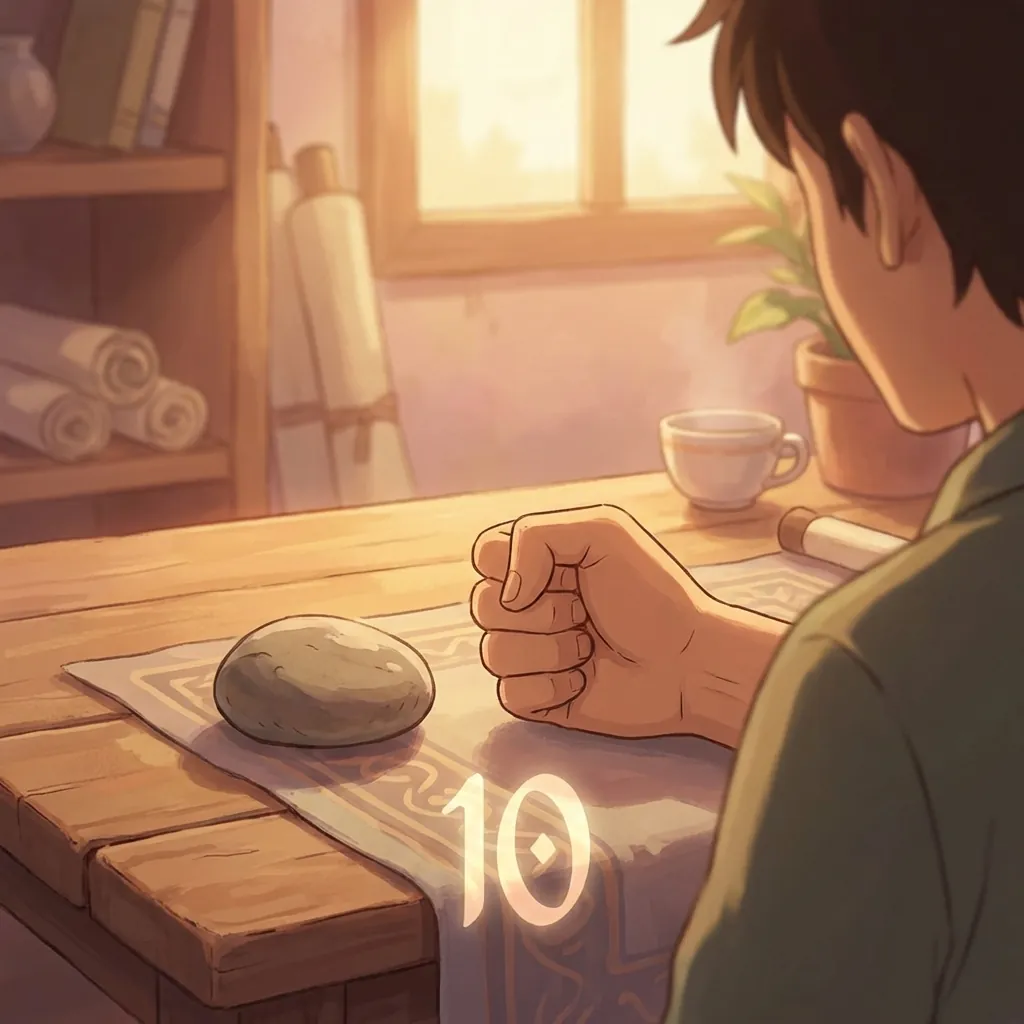
In Northern China (including Beijing), the most common gesture for 10 is a closed fist.
Why? It is a pun.
In Mandarin, the word for "Ten" is Shí (Ten). The word for "Stone" is also pronounced Shí (石).
So, showing a "rock" (fist) is a clever way to say "Ten."
Note: Be careful not to confuse this with zero. Líng (Zero) is usually represented by making an 'O' shape with your thumb and index finger, but in some contexts, a loose fist can imply "nothing." The "Ten" fist is usually tighter and presented knuckles-out.
The Southern Cross
In Southern China, or more formal contexts, you will see a different gesture: taking the index fingers of both hands and crossing them to form an 'X' or '+' shape.
This literally creates the character for ten: 十.
Alternatively, some people cross the index and middle finger of a single hand (like a "fingers crossed for luck" sign), but this is less common than the two-hand cross or the fist.
Vocabulary Recap
| Simplified | Traditional | Pinyin | Meaning | Note |
|---|---|---|---|---|
| 手势 | 手勢 | shǒu shì | Gesture | Generic term |
| 拳头 | 拳頭 | quán tou | Fist | Used for "10" in North |
| 石 | 石 | shí | Stone | Homophone for "10" |
| 八 | 八 | bā | Eight | Looks like the 'gun' gesture |
Regional Variations: Taiwan vs. Mainland
If you travel to Taiwan, the rules for 7, 8, and 9 change completely. This creates endless confusion for counting across the strait.
- Taiwan 7: This looks like the Mainland 8 (Thumb + Index 'L' shape).
- Taiwan 8: Thumb + Index + Middle extended (looks like a gun with an extra barrel).
If you use the Mainland "Gun" (Thumb+Index) in Taipei to order 8 dumplings, you will only get 7.
Why It Matters
Using Shǒu Shì (Gestures) isn't just about looking cool. It solves a major problem: pronunciation ambiguity.
In a loud restaurant, the words for "Four" (四 - Sì) and "Ten" (十 - Shí) sound dangerously similar, especially if you struggle with tones or if the speaker has a strong dialect. Holding up four fingers versus a fist removes all doubt.
Next time you are buying fruit or grabbing a beer, try the one-handed count. Just remember: if you want ten, show them a rock, not two hands.


