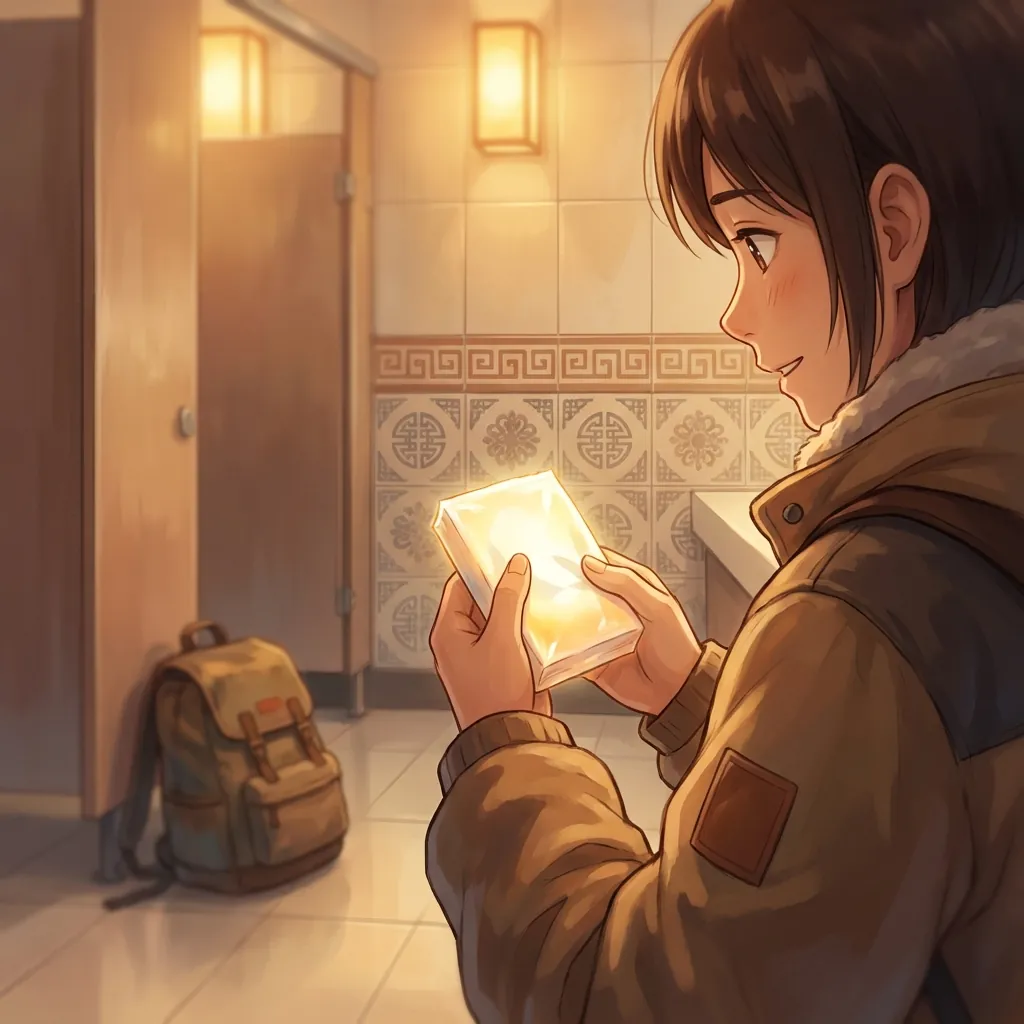
It is the traveler’s worst nightmare. You’ve rushed into a public restroom, successfully navigated the mechanics of the squat toilet, and only then, in the moment of truth, do you look at the holder on the wall. It is empty.
In China, asking for toilet paper in Chinese isn't just a vocabulary lesson; it is a survival skill. Most public restrooms do not provide paper. You are expected to bring your own.
If you are reading this from inside a stall right now: Do not panic. Scroll down to the "Emergency Script" section immediately.
The Golden Rule: BYOTP
The most important lesson here is prevention. In China, you must adopt the BYOTP (Bring Your Own Toilet Paper) lifestyle.
Before you leave your hotel or apartment, check your pockets. If you forget, you need to buy a packet from a convenience store (or sometimes a vending machine outside the restroom).
However, you need to ask for the right kind of paper. If you ask for the wrong thing, you might get a confused look or a giant roll you can't fit in your pocket.
Vocabulary: Know Your Paper Types
There is a critical distinction between the paper you use at home and the paper you carry on the street.
1. The Roll: Wèishēngzhǐ
This is the standard toilet roll. You will see this word on packaging in the supermarket.
| Simplified | Traditional | Pinyin | Meaning | Note |
|---|---|---|---|---|
| 卫生纸 | 衛生紙 | wèishēngzhǐ | Toilet paper | Literal: "Hygiene paper". Usually refers to rolls. |
If you ask a stranger for wèishēngzhǐ 卫生纸, they might think you are asking for a whole roll, which they likely don't have on them.
2. The Packet: Zhǐjīn
This is what you actually want. These are the small, plastic-wrapped packets of tissues sold everywhere. They are stronger than Western Kleenex and are designed for multiple uses (wiping hands, sweat, or... squatting).
| Simplified | Traditional | Pinyin | Meaning | Note |
|---|---|---|---|---|
| 纸巾 | 紙巾 | zhǐjīn | Tissues / Napkins | The packet you carry in your pocket. |
| 面巾纸 | 面巾紙 | miànjīnzhǐ | Facial tissue | Often used interchangeably with zhǐjīn. |
3. The Emergency Verb: Jiè
If you are asking a stranger, you aren't usually "buying" from them; you are "borrowing" (even though you can't give it back).
| Simplified | Traditional | Pinyin | Meaning | Note |
|---|---|---|---|---|
| 借 | 借 | jiè | To borrow / lend | Essential for getting help. |
The Scripts: Asking for Paper
Let’s look at how to use these words in real life.
Scenario A: Buying at the Convenience Store
You are at a 7-Eleven or a small street kiosk. You just need a packet.
老板,有纸巾吗?Pinyin: Lǎobǎn, yǒu zhǐjīn ma?
Meaning: Boss, do you have packet tissues?
If they don't have any, they will use the word méiyǒu 没有 (don't have). If they do, they'll point to a stack on the counter.
Need to know if you can pay with your phone? Check out our guide on paying when cash is refused.
Scenario B: The Stall Panic (Emergency)
You are stuck. The door is closed. You are legally stranded. You hear footsteps outside. You have to shout.
First, you need to get their attention. Politeness is still key, even in a crisis. Don't just scream "Hello!"
Step 1: The Alert
不好意思!外面有人吗?Pinyin: Bù hǎoyìsi! Wàimiàn yǒu rén ma?
Meaning: Excuse me! Is anyone out there?
(We use bù hǎoyìsi 不好意思 here rather than duìbuqǐ 对不起 because you are interrupting, not apologizing for a crime. Read more on sorry nuances here.)
Step 2: The Ask
Once someone answers (usually with a grunt or a Shénme shì? 什么事? meaning "What's up?"), you drop the request.
能借我一点纸吗?我没有纸了!Pinyin: Néng jiè wǒ yīdiǎn zhǐ ma? Wǒ méiyǒu zhǐ le!
Meaning: Can (you) lend me a little paper? I don't have paper anymore!
Note that in this desperate context, you can shorten zhǐjīn to just zhǐ 纸. They will understand what you need.
Step 3: The Handoff
Usually, a kind soul will pass a few sheets under the door or over the divider. You should say:
太感谢了!Pinyin: Tài gǎnxiè le!
Meaning: Thank you so much!
Culture: The Bin and The Pipes
Once you have successfully acquired your paper and finished your business, you face one final hurdle: The disposal.
In the West, we flush. In China, you usually do not flush paper.
- Look for the bin: There will be a waste basket next to the squat toilet filled with used paper. Add yours to the pile.
- Why? Chinese sewage pipes are often narrower and water pressure is lower. Toilet paper, even the biodegradable kind, clogs these systems frequently.
- The Exception: Newer luxury malls or high-speed train stations sometimes allow flushing, but if you see a bin full of paper, follow the local custom. When in doubt, bin it.
If you are dealing with other bathroom anxieties, like figuring out which door is which, check our guide on the Western Toilet Quest. And if this whole ordeal has given you a stomach ache, you might need to visit a pharmacy for la duzi (diarrhea) medicine.
Summary
- Always carry a packet of zhǐjīn 纸巾.
- Ask beforehand if you don't have any: "Yǒu zhǐjīn ma?"
- Don't flush it; put it in the bin.
- If stuck, shout: "Néng jiè wǒ yīdiǎn zhǐ ma?"
Good luck, and may your pockets always be full of tissues.