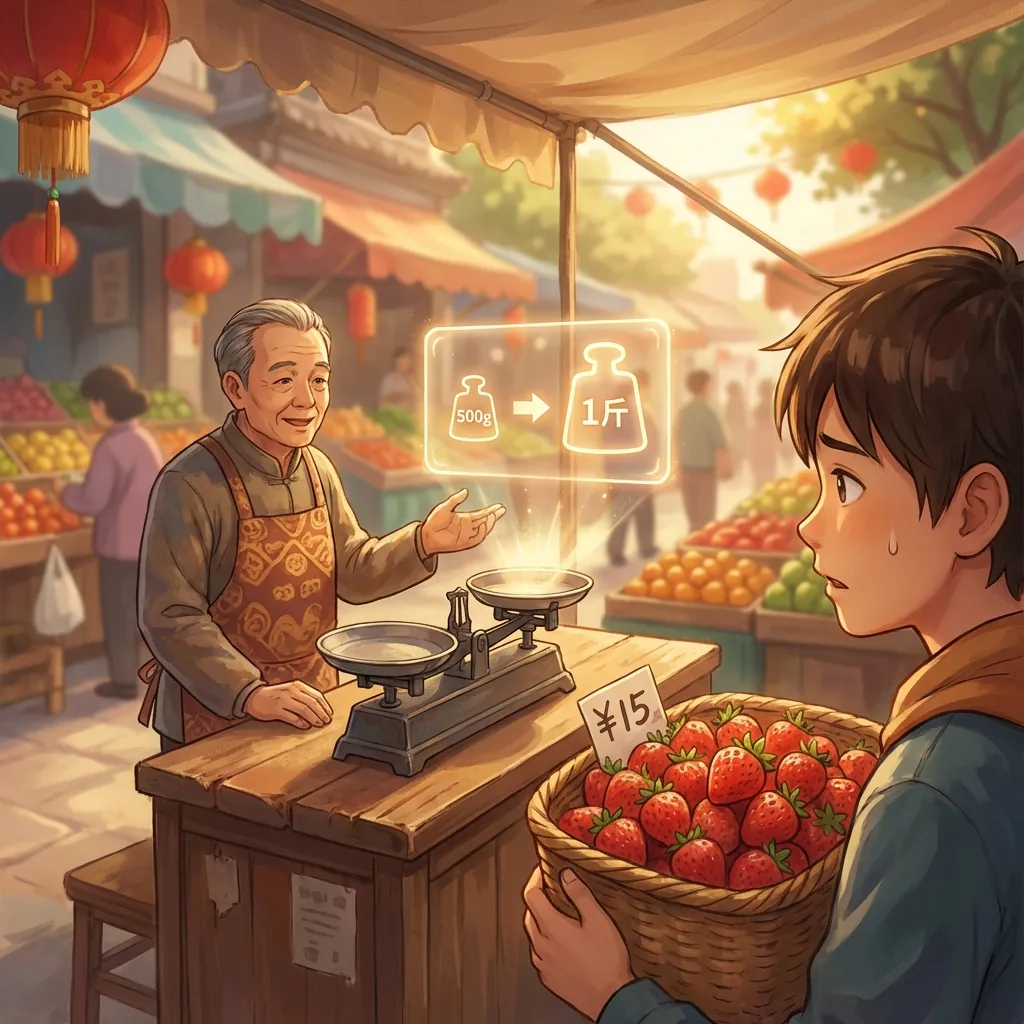
You arrive at a lively street market in Shanghai. You see giant, red strawberries labeled 15元. You think, "Fifteen RMB for a kilo of strawberries? That’s a steal!"
So you fill a bag. The vendor weighs it. Suddenly, you're asked to pay 40元.
What happened? You just fell for the classic Chinese weight unit Jin vs Kilogram fruit market confusion.
In China, the price you see on the street is almost never per kilogram. It is per 斤 (jīn).
Here is how to navigate the market without destroying your grocery budget.
The Core Math: Jin (斤) vs. Kilogram (公斤)
Most Western countries price produce by the pound or the kilogram. China runs on the Jin.
Here is the golden rule you need to memorize:
1 Jin (斤) = 500g (0.5 kg)
That means one Kilogram is exactly two Jin.
In Chinese, a kilogram is called 公斤 (gōngjīn). The character 公 (gōng) essentially marks it as the "metric/public" version.
The Mental Calculation Trick
When you see a price tag on the street (e.g., 10 RMB), assume it is for 500g. To compare it to prices back home or in a supermarket that uses kilos:
Double the displayed price.
- Sign says: 10元 (per Jin)
- Real math: 20元 per Kilogram
If you think in pounds (lbs), 1 Jin is roughly 1.1 lbs. It is close enough to a pound for quick mental math.
Street Smarts: Reading the Price Tag
Where will you see which unit?
1. The Supermarket (The Safe Zone)
Chain supermarkets (like Walmart, Aldi, or Hema) usually display prices in Gōngjīn (Kilogram) or explicitly state "/500g". They are standardized. There is rarely any ambiguity here.
2. The Street Market (The Danger Zone)
At a wet market (càishìchǎng) or a street cart, the unit is always Jīn (Jin), often formally called Shìjīn (市斤).
Usually, the sign won't even write the character 斤. It will just say the number.
草莓 15元(Strawberries 15 RMB [per Jin])
3. The Expensive Trap: Liǎng (两)
Be very careful when buying expensive items like tea, ginseng, or certain dried seafood. Vendors often switch the unit to Liǎng (Tael) to make the price look lower.
1 Liang = 50g (1/10th of a Jin).
If you see tea for "50元", check if it is per Jin or per Liang. If it's per Liang, that tea is actually 500 RMB per Jin. This is also a good time to remember the difference between counting numbers and quantities; check out Er vs Liang if you struggle with counting units.
How to Spot a "Ghost Scale" (Guicheng)
This is the advanced tip that separates tourists from locals. Some dishonest vendors use rigged scales, known in slang as a Guǐ chèng (Ghost scale).
These scales are programmed to show a higher weight than reality. A "nine-liang scale" means 900g of actual weight registers as 1kg on the screen. Some are even worse.
The Counter-Move: The Water Bottle Test
Before you buy, you need a control weight. Luckily, you probably have one in your bag.
A standard 500ml bottle of water weighs exactly 1 Jin (500g).
- Pick up your fruit.
- Casually place your unopened water bottle on their scale first.
- Look at the display.
If it reads 0.500 kg (or very close), the scale is honest. If it reads 0.600 kg or more, simply pick up your bottle and walk away. You don't need to argue; just leave. They know what they did.
Regional Logic: Mainland vs. Hong Kong & Taiwan
If you travel outside Mainland China, the math changes.
- Mainland China: 1 Jin = 500g (standardized metric adaptation).
- Hong Kong / Taiwan: 1 Catty (Jin) ≈ 600g (604.79g).
In Hong Kong wet markets, the "Catty" is heavier. So if the price is the same number, you are actually getting about 20% more fruit in Hong Kong than in Beijing.
Essential Market Vocabulary
You don't need fluent Chinese to buy an apple, but these words help you clarify the price.
| Simplified | Traditional | Pinyin | Meaning | Note |
|---|---|---|---|---|
| 斤 | 斤 | jīn | Jin (500g) | The default unit. |
| 公斤 | 公斤 | gōngjīn | Kilogram | Used in supermarkets. |
| 两 | 兩 | liǎng | Tael (50g) | For herbs/tea. |
| 称一下 | 稱一下 | chēng yīxià | Weigh this | Asking them to check weight. |
| 多少钱 | 多少錢 | duōshao qián | How much? | Universal price question. |
| 太贵了 | 太貴了 | tài guì le | Too expensive | Start bargaining here. |
| 怎么卖 | 怎麼賣 | zěnme mài | How do you sell this? | Asks for price + unit. |
Quick Takeaways
- Assume 500g: Unless labeled "kg", every street price is for 500g.
- Double the Price: Multiply the tag by 2 to get your "per kilo" mental anchor.
- Check the Scale: Put your phone or water bottle on the scale if you suspect a 鬼秤 (Ghost Scale).
- Watch the Unit: For tea or herbs, ensure you aren't paying a "per Liang" price thinking it's "per Jin".