Walking into a salon in a new country is a high-stakes gamble. You sit in the chair, surrender your glasses, and watch a blurry figure approach you with sharp steel. If you want to avoid an unwanted buzzcut, you need to master specific Chinese haircut vocabulary fade trim keep length and understand exactly how a Chinese stylist interprets your request.
To survive this ritual, you need more than just pointing and smiling. You need to stop being polite and start being specific about your boundaries.
The 'Just a Trim' Trap
In English, a "trim" implies maintaining the status quo. It is a preservation of the current style. In Chinese salons, the verb most commonly associated with trimming is 修.
However, 修 also means "to repair" or "to fix." When you tell a barber to 修一下 (trim a bit), they might hear: "My hair is messy; please fix the structure so it looks good." To them, making it look "good" might require cutting three inches off the back to create layers.
Core Vocabulary: Cut vs. Trim vs. Keep
Before you sit down, you need to know the difference between cutting length and changing texture.
| Simplified | Traditional | Pinyin | Meaning | Note |
|---|---|---|---|---|
| 剪 | 剪 | jiǎn | To cut (with scissors) | Implies removing length. |
| 修 | 修 | xiū | To trim / repair | Implies tidying up or shaping. |
| 保留 | 保留 | bǎoliú | To keep / retain | Use this to protect your length. |
| 长度 | 長度 | chángdù | Length | Often paired with bǎoliú. |
| 发梢 | 髮梢 | fàshāo | Hair ends / tips | The target area for a trim. |
If you want to ensure your style doesn't change, you must explicitly state what you want to keep.
请保留这个长度。Please keep this length.
Measurements Over Adjectives
Never use vague adjectives like "a little bit" (一点点). Your definition of "a little" is likely different from the stylist's definition.
Always use centimeters. Even if you use inches at home, switch to the metric system for the salon to avoid conversion errors. Remember the rule for numbers: when quantifying nouns (or centimeters), we often use liǎng instead of èr.
(If you are shaky on this, check out our guide on Er vs Liang).
只剪两公分。Only cut 2 centimeters.
Using 只 (only) acts as a verbal boundary. It signals constraint.
Scenario A: The 'Health' Trim (Long Hair)
You are growing your hair out. You have split ends (分叉). You want the damage gone, but you will cry if you lose length.
Don't just say "trim." Ask for a targeted removal of split ends.
-
You: 我不想变短,只要修一下发梢的分叉。 (I don't want it shorter, just trim the split ends at the tips.)
-
Stylist: 要打薄吗? (Do you want it thinned out/texturized?)
Warning: 打薄 means using thinning shears. If you have thick hair, they love doing this. If you have fine hair or want a blunt cut, refuse this immediately.
- You: 不要打薄,保持厚度。 (Don't thin it out, keep the thickness.)
Scenario B: The Fade (Short Hair)
For men or short hairstyles, a "trim" usually means cleaning up the sides while leaving the top alone. If you want a proper fade, the word is 渐变 (literally: gradual change).
Here is how to manage the risk:
- You: 旁边剪渐变,上面只修一点点。 (Cut a fade on the sides, only trim a tiny bit on top.)
If you are particular about the back of your neck, specifically the nape, you should specify if you want it squared off or natural.
- You: 后面要圆弧的,不要直角的。 (I want the back rounded, not right-angled/squared.)
The 'Layers' Disaster
One of the most common complaints is asking for a trim and receiving a choppy, layered haircut that looks dated. This happens because the stylist is trying to add "movement" to your hair.
If you like your hair all one length, or you want to maintain your current layers without adding new shorter ones, you need to say so.
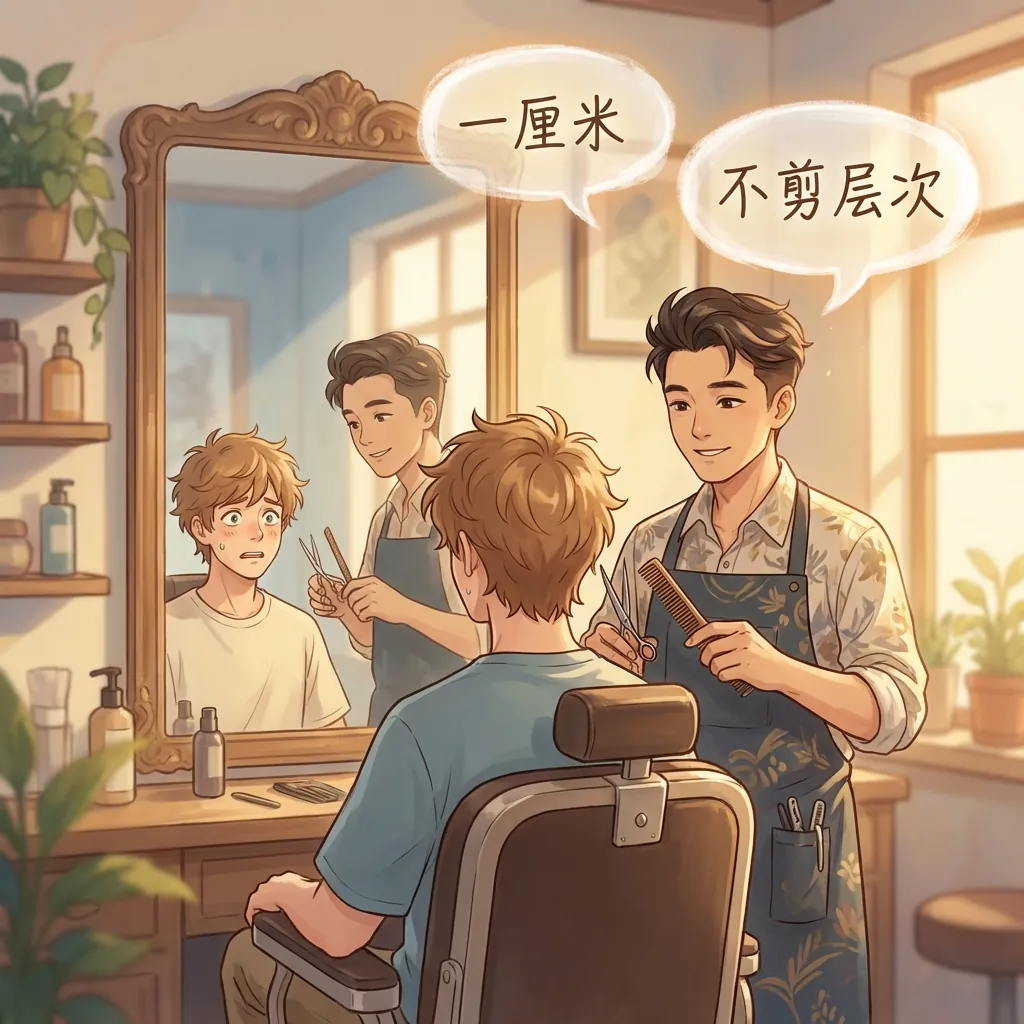
不要剪层次。Don't cut layers.
Or, if you simply want to maintain the current style:
照原来的发型修一下就好。Just trim it according to the original style.
Summary: Your Pre-Chair Checklist
Before the cape goes on, ensure you have communicated these three things:
- Length Limit: "Only 1 centimeter" (State a number).
- The Forbidden Zone: "Don't touch the top/layers" (不要动...).
- The Goal: "Just remove split ends" or "Just clean the neckline."
If you feel your instructions aren't landing, pictures are universal. But backing up that picture with the phrase "请完全按照这个图片剪" (Please cut exactly according to this picture) certainly helps.
Good luck. May your maintenance cut actually be just maintenance.