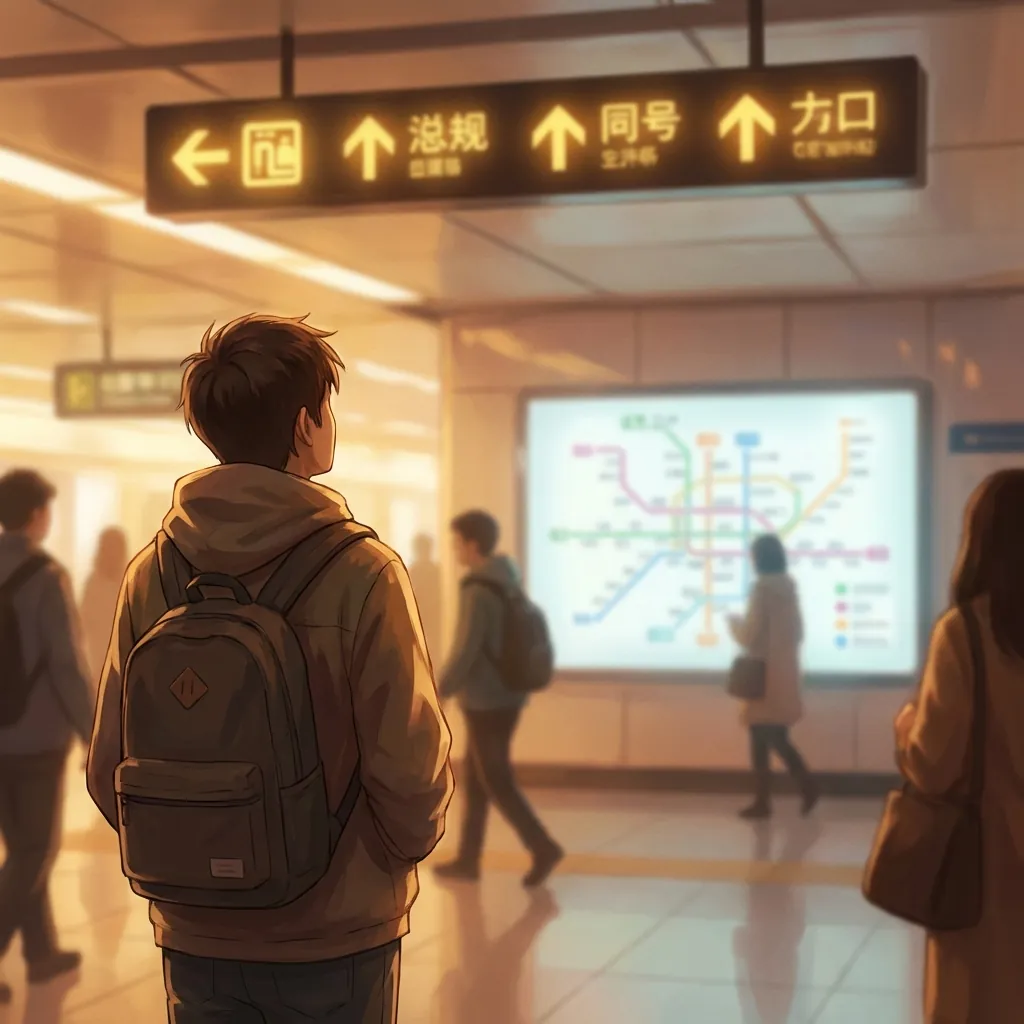
You have successfully navigated the ticket machine and survived the rush hour crush. You are almost there, but now you face the final boss of Chinese urban travel. The difference between a smooth arrival and getting lost usually comes down to identifying subway exit signs, Chinese characters, and directions correctly.
In many Western cities, a subway exit is just a hole in the ground; if you pick the wrong one, you cross the street. In Beijing, Shanghai, or Shenzhen, picking the wrong exit often means you are now separated from your destination by an eight-lane boulevard with fence barriers extending for miles. You cannot just "jaywalk across."
This guide ensures you surface exactly where you need to be, rather than staring helplessly at your hotel from across a highway.
The Alphabet Maze: Why Exits Matter
Chinese subway stations are massive underground complexes. They usually sit directly underneath major intersections (十字路口).
Because the roads above are so wide, urban planners built underground tunnels to connect the four corners. The exits are labeled with letters (A, B, C, D) and sometimes subdivided (A1, A2).
If your map app says "Exit B" and you take "Exit C," you might end up 500 meters away from your target.
Decoding the Logic: The Clockwise Rule
Is there a hidden code to the letters? Yes, usually.
While not a universal law of physics, Chinese urban planning often follows a specific pattern based on cardinal directions. This is why understanding North and South concepts is surprisingly useful underground.
- Exit A: Usually the Northwest corner.
- Exit B: Northeast corner.
- Exit C: Southeast corner.
- Exit D: Southwest corner.
They generally rotate clockwise.
If you know your destination is on the "Southwest corner of the intersection," you can make an educated guess that you want Exit D. However, relying on guesses is risky. That brings us to the golden habit.
The Golden Habit: Map Before Turnstile
Most travelers make the mistake of swiping out of the ticket gates first, then looking for direction.
Don't do this.
Once you exit the turnstiles, you often lose access to the large "Neighborhood Map" (often labeled 街区图). These maps are located in the concourse, the paid area between the train platform and the exit gates.
- Get off the train and go up the escalator.
- Do not exit the gates yet.
- Find the large illuminated yellow or white map on the wall.
- Find your hotel or specific Landmark on that map.
- Note which letter is closest to it.
This is the only way to be 100% sure. Apps like Amap (Gaode) or Baidu Maps will also tell you specifically: "Take Exit B." If you are using these apps, obey them blindly.
Essential Navigation Vocabulary
When scanning the hanging signs, you aren't reading for comprehension; you are scanning for keywords. Here are the characters that matter.
| Simplified | Traditional | Pinyin | Meaning | Note |
|---|---|---|---|---|
| 出口 | 出口 | chū kǒu | Exit | The most important word. Follow the arrow. |
| 北 | 北 | běi | North | Often implies Exit A or B. |
| 地标 | 地標 | dì biāo | Landmark | Look for this header on info boards. |
| 十字路口 | 十字路口 | shí zì lù kǒu | Intersection | Literally "Ten character road mouth" (shape of +). |
| 换乘 | 換乘 | huàn chéng | Transfer | Do not follow this if you want to leave! |
Usage Example
If you ask a station attendant for help, keep it simple. You don't need complex grammar.
-
You: 请问,A出口在哪里?
- (Qǐngwèn, A chūkǒu zài nǎlǐ?)
- "Excuse me, where is Exit A?"
-
Attendant: 在那边,左转。
- (Zài nàbiān, zuǒ zhuǎn.)
- "Over there, turn left."
If you are confused about which exit leads to a specific place, utilize the location logic you've learned:
- You: 去万达广场走哪个出口?
- (Qù Wàndá Guǎngchǎng zǒu nǎge chūkǒu?)
- "To go to Wanda Plaza, walk [which] exit?"
Quick Takeaways
- Stop guessing. The "surface and see" method does not work in China due to massive road infrastructure.
- Clockwise Logic. A is usually Northwest. B is Northeast. Use this for general orientation.
- Map First. Locate the neighborhood map inside the ticket barriers to confirm your exit letter.
- Ignore 'Transfer'. Ensure you are following signs for 出口 (Exit), not 换乘 (Transfer).
The difference between a stressful arrival and a smooth one is often just checking that one letter before you tap your card.