You have been walking around Shanghai or Beijing for three days. Your feet are throbbing, and your back feels like it has fused into a single solid block. You see a sign with the characters Ànmó (Massage) and Mángrén (Blind Person). If you want to navigate this experience without leaving black and blue, you need specific Chinese massage vocabulary for pain, pressure, lighter, and stronger adjustments.
This is not a spa. There are no scented candles, no whale sounds, and definitely no cucumber water. This is a clinic. Without these words, you are entirely at the mercy of a therapist who believes they are saving your life by crushing your shoulder blades.
The White Coats and Dark Glasses
Blind massage, or 盲人按摩 (Mángrén ànmó), is a ubiquitous institution in China. It is reliable, incredibly affordable, and strictly therapeutic.
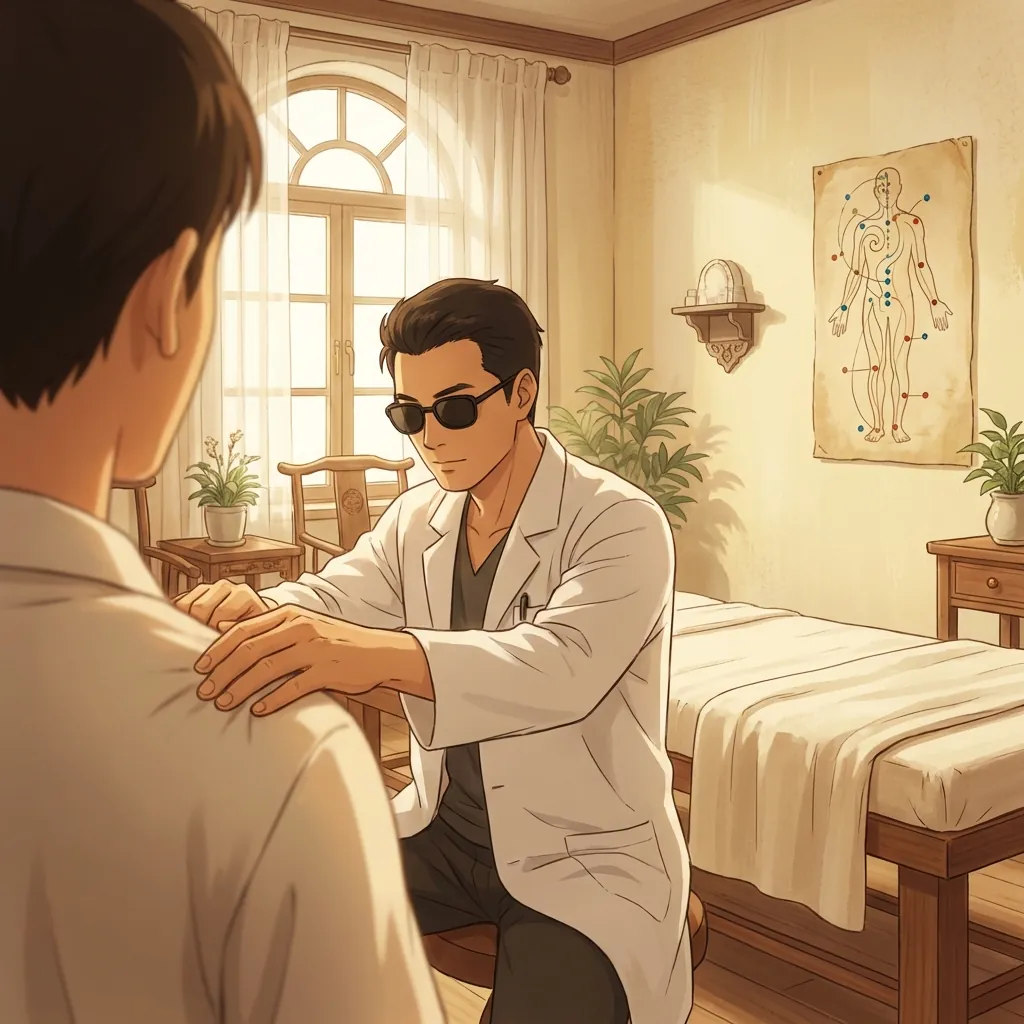
The setup is usually clinical. You walk in, and you will see rows of beds covered in clean sheets. The therapists often wear white lab coats and dark glasses. It looks more like a hospital ward than a relaxation center because, historically and culturally, it is treated as a medical service.
Why the blind? In China, massage therapy has been a government-supported vocation for the visually impaired since the 1950s, building on a tradition that goes back to the Tang Dynasty monk Jianzhen. These therapists undergo rigorous training in anatomy and Tuīná (Push and Grasp), a pillar of Traditional Chinese Medicine (TCM).
It’s Not a Spa Day
If you are used to Swedish massage (long, gliding strokes and oil), you are in for a shock. Tuīná is dry (clothes stay on) and dynamic. It involves pressing, kneading, and chopping.
The goal isn't to make you sleep; the goal is to fix you. And fixing you requires force.
The Golden Rule: Suān vs. Tòng
This is the most important concept in Chinese massage. In English, we often just say "it hurts." In Chinese, there are two distinct types of pain, and mixing them up will ruin your session.
1. Suān (The Good Pain)
酸 (Suān) literally means "sour." In a massage context, it refers to that deep, aching soreness you feel when someone presses on a knot. It is intense, but it feels therapeutic.
If the therapist asks if it hurts and you feel this deep ache, you should actually tell them it is Suān. This tells them, "You found the spot, keep going."
这儿很酸。(Zhèr hěn suān.)
It feels sore/achy right here (in a good way).
2. Tòng (The Bad Pain)
痛 (Tòng) is sharp, injury-level pain. This is pinching, bone-grinding, or nerve-striking pain.
If you say Tòng, the therapist should stop or lighten up immediately. If you mistakenly yell "Tòng!" when you actually mean "Suān," they will stop working on the very knot that needs fixing.
Survival Vocabulary: The Pressure Matrix
You are lying face down. The therapist is digging an elbow into your lower back. You need to communicate fast. Do not worry about perfect grammar; short commands are better here.
Just like when giving commands to a Didi driver, clarity is king.
| Simplified | Traditional | Pinyin | Meaning | Note |
|---|---|---|---|---|
| 痛 | 痛 | Tòng | Painful / It hurts | Use for sharp pain only. |
| 酸 | 酸 | Suān | Sore / Achy | Use for deep tissue release. |
| 轻一点 | 輕一點 | Qīng yīdiǎn | A little lighter | The most useful phrase you will learn. |
| 重一点 | 重一點 | Zhòng yīdiǎn | A little heavier | For the brave. |
| 舒服 | 舒服 | Shūfu | Comfortable | The highest compliment. |
| 这里 | 這裡 | Zhèlǐ | Here | Use to guide their hand. |
| 不行 | 不行 | Bùxíng | Not okay / Stop | Emergency brake. |
Practical Dialogue Examples
Scenario 1: It is too painful.
- You: 太痛了,轻一点! (Tài tòng le, qīng yīdiǎn!)
- Therapist: 好。 (Hǎo.)
Scenario 2: They found the spot.
- Therapist: 疼吗? (Téng ma?) : Does it hurt? (Note: Téng is a synonym for Tòng)
- You: 有点酸,但是很舒服。 (Yǒudiǎn suān, dànshì hěn shūfu.) : It's a bit sore, but very comfortable.
If you want to sound like a local, you can address the therapist as 师傅 (Shīfu). This is a respectful title for skilled workers, similar to how you address a taxi driver.
How to Spot a Legit Parlor
Not all massage signs are created equal. In China, massage parlors generally fall into two categories: legitimate therapeutic clinics and... "entertainment" venues.
To avoid an awkward situation, look for these green flags:
- Uniforms: White coats or matching polo shirts.
- Anatomy Charts: Posters of meridian lines and skeletal structures on the wall.
- Lighting: Bright, fluorescent lighting. If the lights are dim and pink, keep walking.
- Open Doors: The treatment rooms often have curtains rather than locked doors, or the front door is wide open to the street.
Walking on Clouds
When the session ends, you might feel like you've gone a few rounds in a boxing ring. You will be disoriented. You might be thirsty.
But give it ten minutes. As you walk down the street, you will realize your shoulders have dropped three inches and your headache is gone. That is the magic of Shūfu. The "good pain" pays off.
Just remember: if it's sharp, say Tòng. If it's deep, say Suān. And if you can't handle it, there is no shame in shouting Qīng yīdiǎn!