The GPS says you have arrived. You can see your apartment building. But the driver keeps going, or worse, stops in the middle of a four-lane avenue while cars honk behind you. Knowing telling taxi driver to stop specific location chinese phrases is the difference between a smooth exit and a stressful dash across traffic.
Navigation apps in China are generally excellent, but the "final 100 meters" usually require human intervention. You need to tell the driver exactly where to pull over, and more importantly, you need to understand why they sometimes refuse to stop where you want them to.
The "Final 100 Meters" Problem
Before you start shouting commands, you need to address the driver properly. Do not just shout "Hey!"
The universal term is Shīfu (Master/Worker). It works for taxi drivers, Didi drivers, and even bus drivers.
师傅,到了。
师傅,到了。Shīfu, dàole. Driver, [we have] arrived.
This is the bare minimum. But usually, you need more precision. Location logic in Chinese puts the location before the action (mostly), which we cover in location sentence structure, but imperative commands are often shorter.
Precision Parking: "Pull Over" Like a Pro
If you simply say "stop" (tíng), a panicked driver might slam on the brakes in the middle of the lane. You want them to pull over.
The Magic Word: 靠边 (Kàobiān)
This is the single most useful phrase for taxis. It means "lean to the side."
| Simplified | Traditional | Pinyin | Meaning | Note |
|---|---|---|---|---|
| 靠边停 | 靠邊停 | Kàobiān tíng | Pull over / Stop by the curb | The Gold Standard command |
| 就在这儿停 | 就在這兒停 | Jiù zài zhèr tíng | Stop right here | Use only if immediate stop is safe |
| 前面停 | 前面停 | Qiánmian tíng | Stop up ahead | Gives the driver time to react |
师傅,麻烦前面靠边停。
师傅,麻烦前面靠边停。Shīfu, máfan qiánmian kàobiān tíng. Driver, please pull over up ahead.
Avoiding Tickets: The "Camera" Conversation
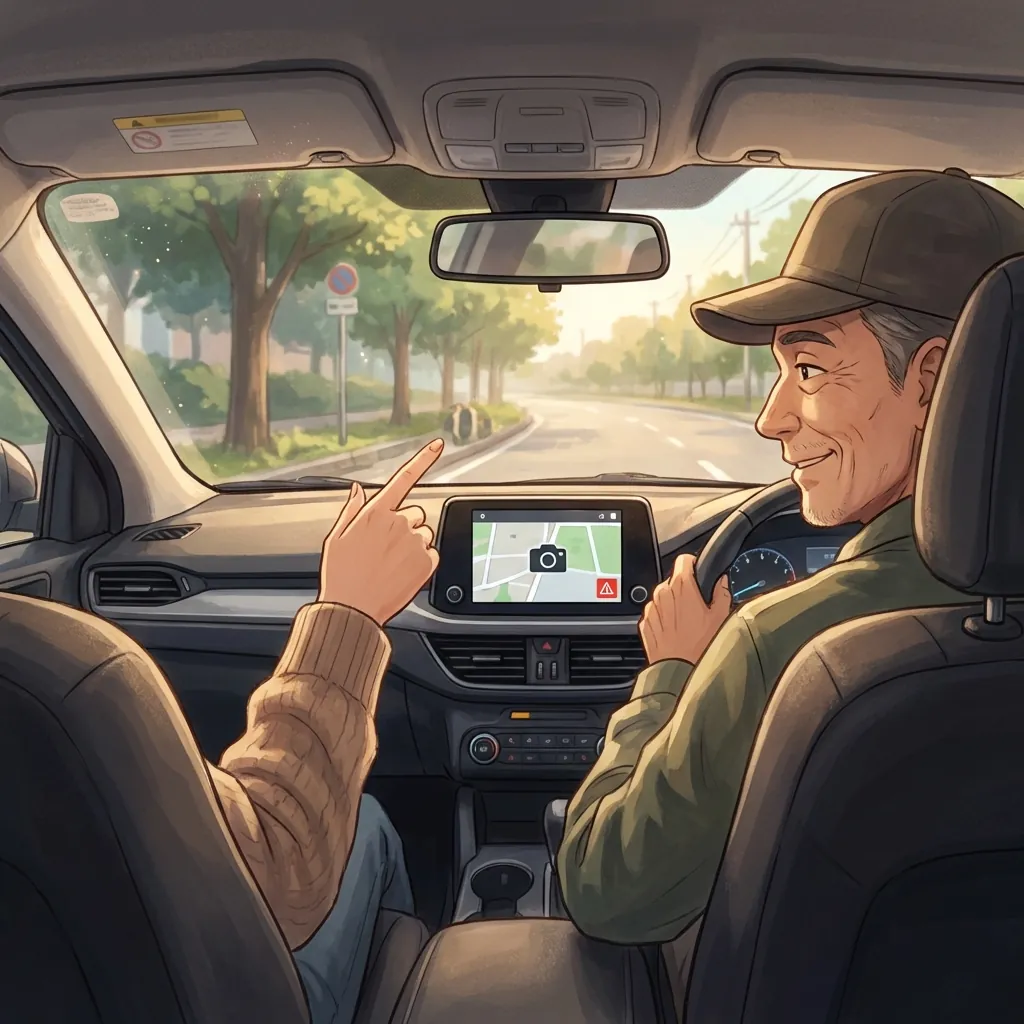
Sometimes you ask a driver to stop, and they ignore you or shake their head. They aren't being rude; they are terrified of Shèxiàngtóu (traffic cameras).
In major Chinese cities, automatic cameras photograph cars stopping in illegal zones (like near bus stops or crosswalks). The fine is often 200 RMB and points on their license. 200 RMB might be their profit for the entire day.
If they say 拍照 (Pāizhào, taking photos) or 有监控 (Yǒu jiānkòng, there is monitoring), do not argue. Just say:
那去前面没有摄像头的地方。
那去前面没有摄像头的地方。Nà qù qiánmian méiyǒu shèxiàngtóu de dìfang. Then go ahead to a place without cameras.
Specific Landmarks
Often the GPS pin is slightly off. You need to guide them to a physical object.
Intersections and Lights
The word for intersection is Lùkǒu (Road mouth).
就在路口停。
就在路口停。Jiù zài lùkǒu tíng. Stop right at the intersection.
过红绿灯停。
过红绿灯停。Guò hónglǜdēng tíng. Stop after [passing] the traffic light.
Gates and Entrances
If you live in a gated community (xiǎoqū), simply saying the name of the complex isn't enough. They need to know which gate.
| Simplified | Traditional | Pinyin | Meaning |
|---|---|---|---|
| 北门 | 北門 | Běi mén | North gate |
| 南门 | 南門 | Nán mén | South gate |
| 大门口 | 大門口 | Dà ménkǒu | Main entrance |
If you struggle with directions, review North vs South orientation basics.
Correcting the GPS (When the Pin is Wrong)
Sometimes the map thinks you are on the overpass, but you are actually on the side road. You need to take control.
"Keep going straight"
Use this when the driver starts slowing down too early.
一直走,别拐弯。
一直走,别拐弯。Yīzhí zǒu, bié guǎiwān. Go straight, don't turn.
"You missed the turn"
If they miss it, you usually need them to turn around. The specific command for a U-turn is Diàotóu.
师傅,走错了。请掉头。
师傅,走错了。请掉头。Shīfu, zǒucuò le. Qǐng diàotóu. Driver, [we] went the wrong way. Please U-turn.
Note the usage of Le (了) here to indicate the mistake has already happened (change of state).
Summary: 5 Phrases to Memorize
If you only remember five things from this article, make it these. They cover 90% of Didi interactions.
- 师傅 (Shīfu) - Driver (start every sentence with this).
- 靠边停 (Kàobiān tíng) - Pull over to the curb.
- 这就到了 (Zhè jiù dào le) - We are arriving right now (be ready).
- 前面路口 (Qiánmian lùkǒu) - At the intersection ahead.
- 这里不能停 (Zhèlǐ bùnéng tíng) - You can't stop here (acknowledging the camera risk).
Mastering these commands allows you to exit the car calmly, rather than tucking and rolling out of a moving vehicle.