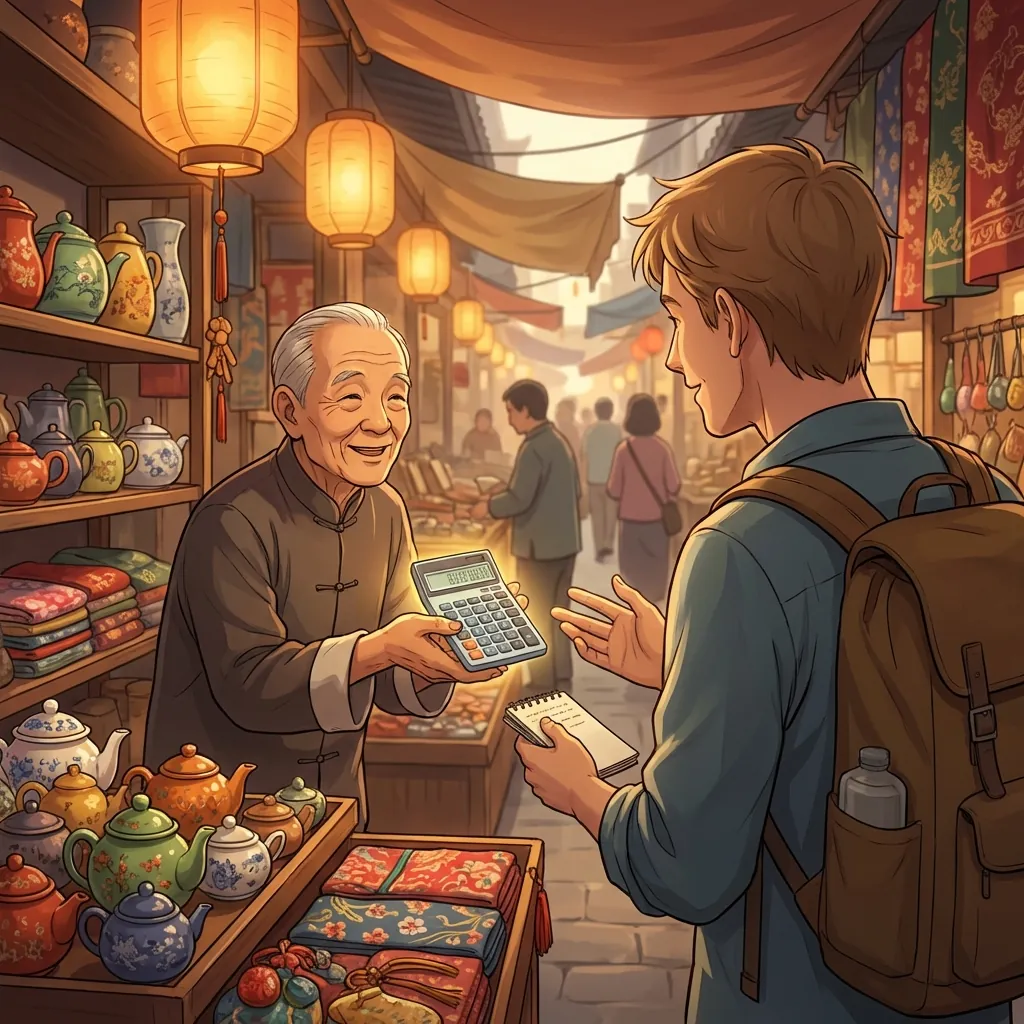
You are standing in a busy market. You spot a vintage-looking tea set. You ask the price. The shopkeeper punches numbers into a calculator and shows you: 800. You realize you don't know the beginner Chinese bargaining phrases market vendors expect. Your gut tells you this is too high, but you don't want to cause a scene. Do you pay it? Do you run away?
If you pay the 800, you are likely paying what expats call the "foreigner tax." But bargaining doesn't have to be an aggressive shouting match. It is a social dance.
In this guide, we will strip away the anxiety and give you the specific vocabulary you need. We will cover how to spot a rip-off, the grammar of politeness, and the ultimate move: the walk-away.
Phase 1: The Reality Check (Is This Price Real?)
Before you even open your mouth to haggle, you need to know if you are in the right venue. You cannot bargain everywhere.
Signs of Fixed vs. Flexible Pricing
- The Barcode Rule: If an item has a printed barcode or a printed price tag that looks like it came from a factory, the price is likely firm. Do not try to bargain at a 7-Eleven or a UNIQLO.
- The Handwritten Label: If the price is written on a piece of cardboard or masking tape, it is open for discussion.
- The Verbal Price: If there is no price visible and you have to ask, the price is 100% flexible. The seller is sizing you up.
The Unit Trap
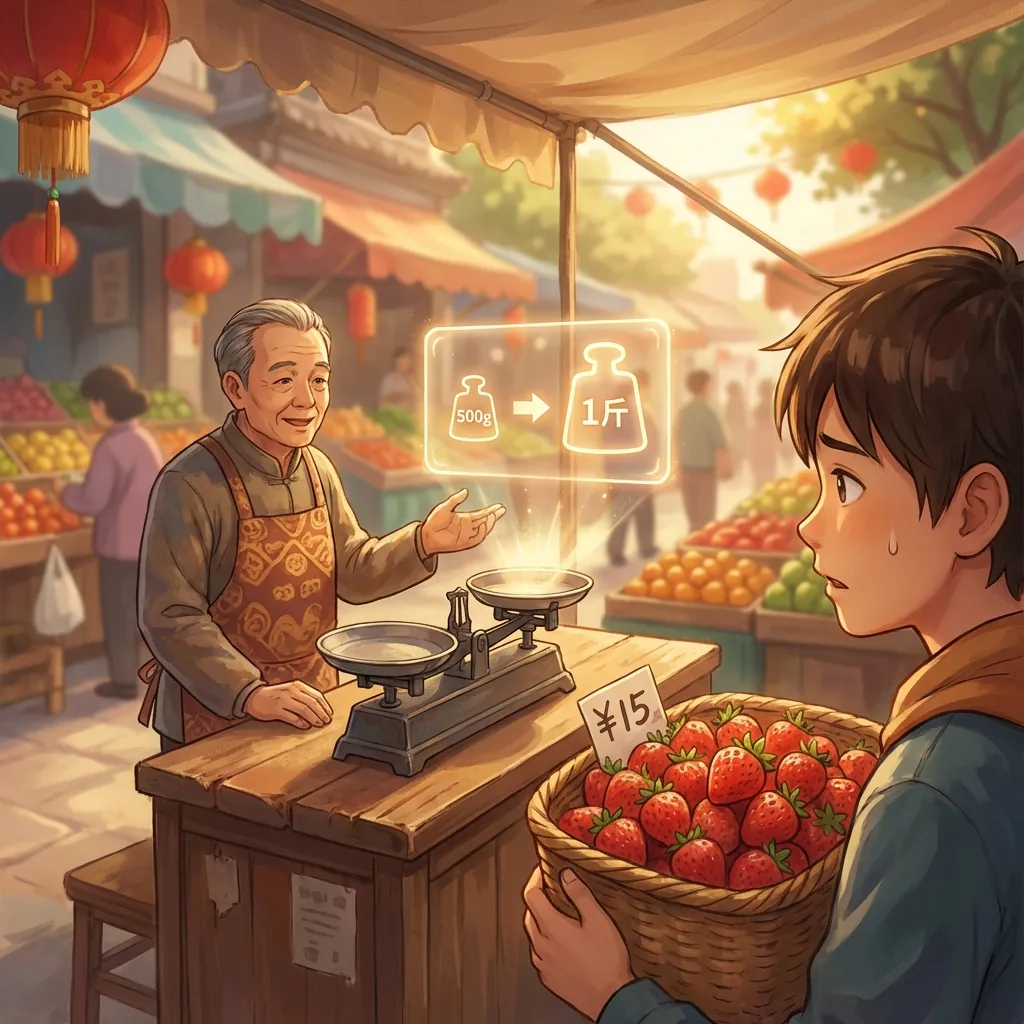
A classic mistake beginners make happens in fruit markets. You see a sign that says "5 Yuan" and think it is a steal for a kilogram. But in China, the standard unit is often the Jin (500g), not the Kilogram.
If you aren't clear on this, you will end up paying double what you expected. Check my guide on Jin vs. Kilogram to avoid this specific math headache.
Phase 2: The Grammar of Politeness
Many learners worry that bargaining makes them look cheap or rude. The difference between "rude" and "savvy" is often just a matter of grammar.
Direct commands sound harsh. We use modal verbs and particles to soften the blow.
Softening the Request
Instead of just saying "Cheaper!" (便宜! Piányi!), use the potential form.
| Simplified | Traditional | Pinyin | Meaning | Note |
|---|---|---|---|---|
| 能便宜点吗? | 能便宜點嗎? | Néng piányi diǎn ma? | Can it be a little cheaper? | Néng (can) makes it a request. |
| 太贵了吧。 | 太貴了吧。 | Tài guì le ba. | That's a bit too expensive. | Ba softens the statement significantly. |
| 给个优惠吧。 | 給個優惠吧。 | Gěi gè yōuhuì ba. | Give me a discount/deal. | Yōuhuì implies a special deal/privilege. |
Using 吧 (ba) is a cheat code for sounding friendly. It turns a statement of fact ("It is expensive") into a suggestion ("It seems a bit expensive, don't you think?").
Phase 3: The Negotiation Dance
Once you have established the item is negotiable, the dance begins.
Step 1: The Flinch
When the seller shows you the price on the calculator, you must react. If you look indifferent, you lose leverage. You need to express shock, but with a smile.
哇,太贵了!Wa, tài guì le! Whoa, too expensive!
Step 2: The Counteroffer
This is where it gets tricky. In tourist traps (like the Shanghai Science and Technology Museum Market), the starting price might be 10x the real value. In a local neighborhood market, it might only be 20% higher.
If you are in a tourist market, be bold. If they say 500, you might offer 100.
一百卖不卖?Yībǎi mài bú mài? Will you sell it for 100?
This structure "[Price] + 卖不卖" is the standard way to propose a counteroffer.
Step 3: Meeting in the Middle
The seller will pretend to be insulted. They might say:
- 不行,亏本了。 (Bùxíng, kuīběn le.): No way, I'd lose money.
- 再加一点。 (Zài jiā yīdiǎn.): Add a little more.
At this point, you can inch up slowly. But do not go up as fast as they come down.
Phase 4: The Graceful Exit
Sometimes, you just can't agree on a price. Or maybe you want to test if their "lowest price" is actually their lowest. This is when you use the most powerful move: Walking Away.
How to do it politely
You don't need to storm off. You can use 不好意思 (bùhǎoyìsi) effectively here. (See: Duibuqi vs Buhaoyisi).
不好意思,还是太贵了。我再看看。Bùhǎoyìsi, háishì tài guì le. Wǒ zài kànkan. Sorry, it's still too expensive. I'll look around some more.
Then, slowly walk toward the exit.
The Golden Rule: If they let you walk out the door and disappear, your price was genuinely too low. If they shout "Wait!" or "Come back!" (回来! Huílái!), you have won. They are ready to accept your offer or get very close to it.
Quick Takeaways
- Do smile. Bargaining is often considered a friendly interaction, not a fight.
- Don't bargain if you have no intention of buying. If they accept your price, social etiquette dictates you should buy it.
- Do check your numbers. If you struggle with saying large numbers, review Er vs Liang to make sure you aren't saying "two" when you mean "two hundred" incorrectly.
- Don't obsess over saving the last 5 RMB. If the price difference is less than a dollar, sometimes it's worth saving your time instead.
Bargaining is a skill that improves with practice. Start with small items like socks or fruit, and soon you'll be handling the markets like a local.