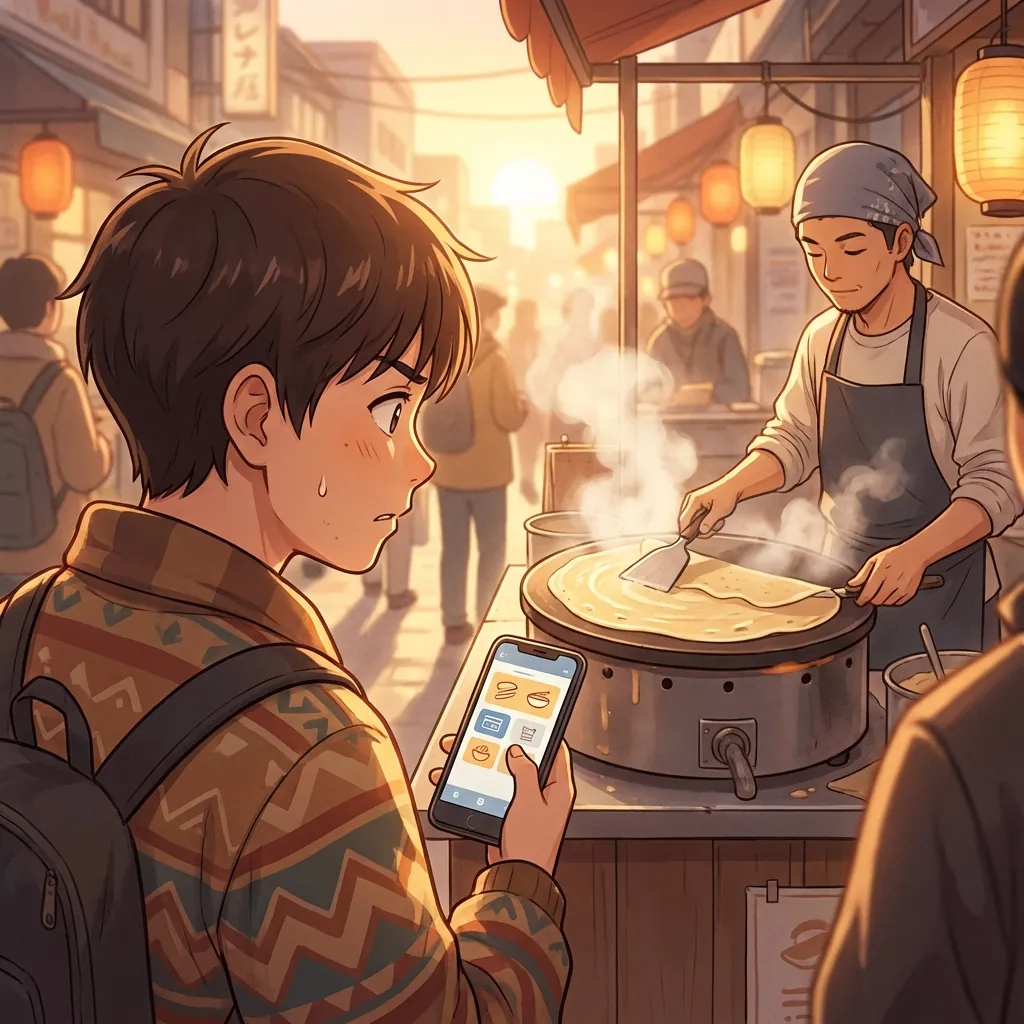
There is a specific anxiety that comes with buying breakfast in China. It isn't about the food safety. It is about learning how to order jianbing ingredients in Chinese with enough speed to survive the morning rush. The Jiānbing (Chinese savory crêpe) vendor is a machine of efficiency. They are spreading batter, cracking eggs, and flipping dough at a rhythm that waits for no one.
When it is your turn, you have about five seconds to specify exactly what you want before the sauce hits the crepe. If you hesitate, you hold up the line of impatient commuters behind you.
This guide breaks down the process from the initial egg count to the final payment scan, so you can walk away with breakfast instead of embarrassment.
The Anatomy of a Jianbing
Before you start talking, you need to know what you are looking at. A standard Jianbing isn't just a pancake; it is a structural assembly of textures.
The most critical ingredient distinction is the crunch. Some places offer a 油条 (dough stick), but the classic crunch comes from the fried cracker.
Essential Ingredient Vocabulary
| Simplified | Traditional | Pinyin | Meaning | Note |
|---|---|---|---|---|
| 薄脆 | 薄脆 | Báocuì | Crispy cracker | The soul of the Jianbing. |
| 鸡蛋 | 雞蛋 | Jīdàn | Egg | Usually one is standard. |
| 火腿 | 火腿 | Huǒtuǐ | Ham | Often a processed hot-dog style sausage. |
| 生菜 | 生菜 | Shēngcài | Lettuce | Adds freshness. |
| 面酱 | 麵醬 | Miànjiàng | Bean sauce | The sweet/salty base sauce. |
If you want to sound like a local, know the difference between Báocuì and 油条. If you point at the square cracker and call it a doughnut, the vendor will understand you, but they will judge you.
Level 1: The Quantity
Step up to the cart. The vendor might not even look at you; they are likely staring at the griddle. They will grunt something like:
几 个?Jǐ ge?
How many?
Keep it simple. You just need the number and the item.
一个。Yí ge.
One.
If you want two, remember to use Liǎng (two) instead of Er.
Level 2: The Garnish Rapid-Fire
This is where most learners panic. Once the egg is smashed onto the batter, the vendor will mumble a string of ingredients very fast. They are asking what you want to add or remove.
The holy trinity of garnishes is: Cilantro, Green Onion, and Pickles.
| Simplified | Pinyin | Meaning |
|---|---|---|
| 香菜 | Xiāngcài | Cilantro / Coriander |
| 葱花 | Cōnghuā | Chopped Green Onion |
| 榨菜 | Zhàcài | Pickled Mustard Tuber |
The vendor asks:
葱花香菜都要吗?Cōnghuā xiāngcài dōu yào ma?
Do you want both green onions and cilantro?
Scenario A: You eat everything
This is the easiest path. You just confirm everything.
都要。Dōu yào.
(I) want all of it.
Scenario B: The Cilantro Hater
If you have the genetic trait that makes Xiāngcài taste like soap, you must speak up immediately after saying "one jianbing."
不要香菜!Bú yào xiāngcài!
Don't want cilantro!
Pro tip: Say this loud. Muscle memory drives the vendor's hand; if you whisper, the cilantro will be on your food before your sentence is finished.
Level 3: The Spice Negotiation
Sauce is the final step. The vendor will hold a ladle or a brush and look at you.
放辣吗?Fàng là ma?
Put spice (in it)?
Or simply:
吃辣吗?Chī là ma?
Eat spice?
You need to answer with your desired level from the spicy scale. Since Làjiāo (chili) in Jianbing is usually a paste, it spreads easily.
- Bú yào là (No spice)
- Wēi là (A little spice / Micro spice)
- Zhōng là (Medium spice)
If you say nothing, you might get the default, which varies by region. In the north, it's usually mild. In the southwest, the "default" might destroy your morning.
Level 4: Closing the Transaction
The Jianbing is folded. The spatula cuts it in half. Now comes the logistics.
To go or eat here?
Usually, street food is "to go" by default. But they might ask:
打包吗?Dǎbāo ma?
Packing (take away)?
You answer:
对,打包。Duì, dǎbāo.
Correct, pack it.
The Payment Dance
Cash is rarely accepted or seemingly "out of change." You need WeChat or Alipay. The vendor will point to a QR code hanging on the cart.
扫个码。Sǎo ge mǎ.
Scan the code.
This uses the verb Sǎomǎ. You scan them, type in the amount (usually 6 to 10 RMB), and show them the screen. For a detailed breakdown of this anxiety-inducing moment, check out our guide on scanning vs being scanned.
Summary Cheat Sheet
Here is your script for tomorrow morning. Memorize it.
- Vendor: "Jǐ ge?"
- You: "Yí ge."
- Vendor: "Xiāngcài yào ma?"
- You: "Bú yào xiāngcài. Wēi là."
- Vendor: (Points at QR code)
- You: (Scan, pay, show screen)
Congratulations. You have successfully acquired breakfast.