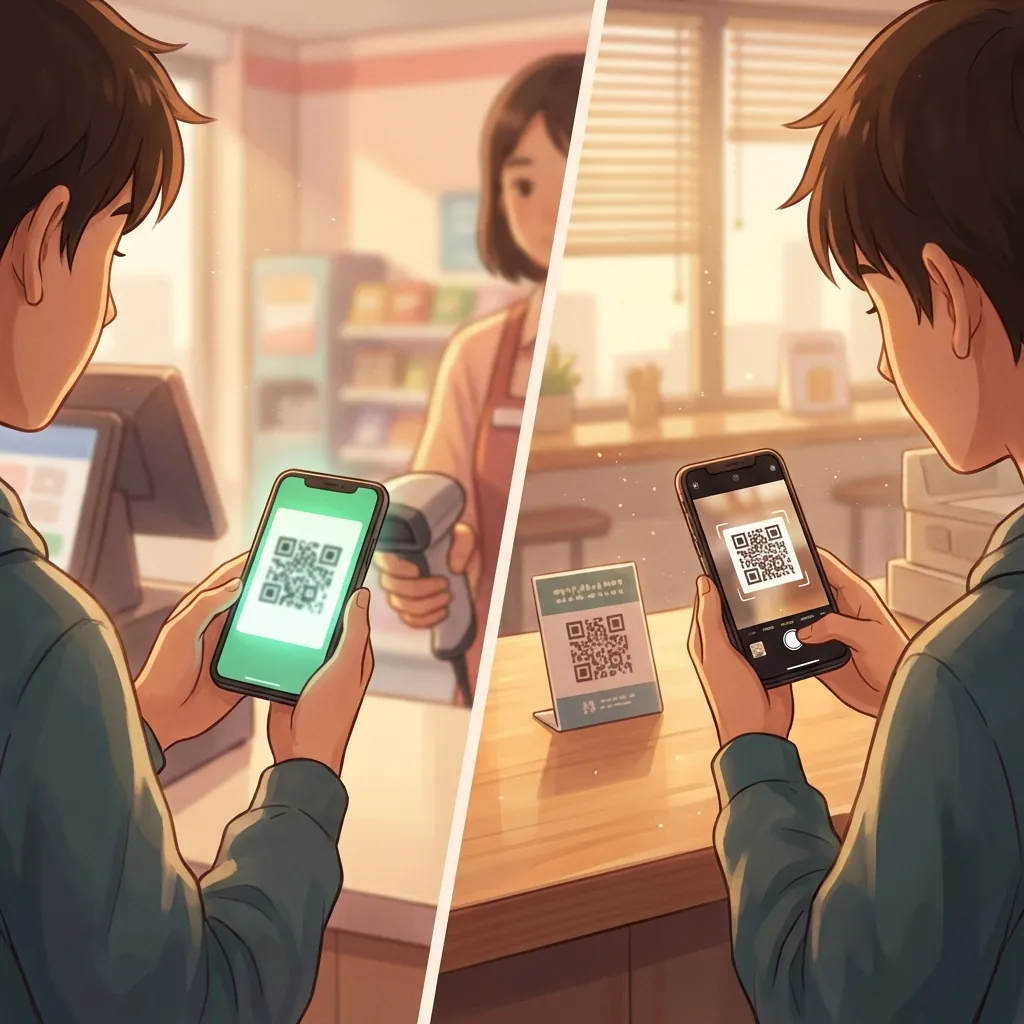
There is a specific moment of panic that every foreigner in China knows. You are at the counter of a busy 7-Eleven. There is a line of impatient people behind you. The cashier mumbles something rapid-fire.
Do you hold up your phone? Do you point your camera at them?
This is the Scan vs. Be Scanned loop. In China, paying isn't just a transaction; it's a micro-social interaction that requires you to identify who is the active agent and who is the passive target.
If you get it wrong, you stand there awkwardly holding your phone screen at a cashier who is waiting for you to scan the little plastic stand.
Let's break down the vocabulary and the psychology to get you through the checkout line without sweating.
Introduction: The Invisible Barcode
Social anxiety researchers talk about the 'Spotlight Effect' - the feeling that everyone is watching you. In China, modern life has turned this metaphor into a literal mechanic.
You are constantly toggling between two modes:
- Scanning (Active): Looking for information (QR codes, menus).
- Being Scanned (Passive): Presenting yourself (Payment codes, Health codes).
The core verb here is 扫 (sǎo), which means "to scan" or "to sweep."
At the register, the confusion usually stems from not knowing which mode to initiate. Here is the golden question you are trying to answer:
我扫你,还是你扫我?Pinyin: Wǒ sǎo nǐ, háishì nǐ sǎo wǒ?
Meaning: Do I scan you, or do you scan me?
Mode 1: 'Be Scanned' (The Spotlight Effect)
In this mode, you are the target. The cashier has a scanner gun (or a box on the counter), and they need your unique code.
The Sensation: You feel like a walking QR code. The pressure is on you to have your app ready. If your internet is slow, you feel the collective sigh of the line behind you. This triggers the 'Spotlight Effect' - you think everyone is judging your slow loading speeds.
The Vocabulary:
| Simplified | Traditional | Pinyin | Meaning | Note |
|---|---|---|---|---|
| 付款码 | 付款碼 | fùkuǎn mǎ | Payment Code | This is the barcode you show to pay. |
| 你扫我 | 你掃我 | nǐ sǎo wǒ | You scan me | The command for this mode. |
| 让一下 | 讓一下 | ràng yīxià | Let me through/Move a bit | Useful if you are blocking the scanner. |
The Reality Check: The cashier is not judging your Chinese or your loading speed. They are an NPC (Non-Player Character) following a script. They just want the 'beep' sound so they can move to the next customer.
If you fumble, don't apologize profusely. A simple 不好意思 (bù hǎoyìsi) is enough. For more on this, check out my guide on when to use buhaoyisi vs duibuqi.
Mode 2: 'The Scanner' (Hypervigilance)
In this mode, you are the hunter. You need to find the merchant's QR code sticker. It's usually taped to the counter, on a small plastic stand, or sometimes worn on a lanyard.
The Mechanism: Your eyes are radar. You are looking for the green (WeChat) or blue (Alipay) square.
The Vocabulary:
| Simplified | Traditional | Pinyin | Meaning | Note |
|---|---|---|---|---|
| 扫一扫 | 掃一掃 | sǎo yī sǎo | Scan (function) | The name of the camera function in apps. |
| 我扫你 | 我掃你 | wǒ sǎo nǐ | I scan you | Stating your intent. |
| 码在哪? | 碼在哪? | mǎ zài nǎ? | Where is the code? | Casual way to ask where to scan. |
The Error: Anxiety often makes us 'Hypervigilant.' You might be looking so hard for social cues (is the cashier angry?) that you miss the obvious QR code right in front of your face.
The Glitch: How They Feed Each Other
The awkward dance happens when both parties enter the same mode.
- Scenario A: You hold out your phone (Be Scanned) while the cashier points at the sticker (expecting you to Scan).
- Scenario B: You try to scan the cashier's face (don't do this) while they are waiting for your code.
This is often where learners freeze. You might want to say, "Can I scan you?" but you get stuck on the grammar. (Tip: check Hui vs. Neng vs. Keyi for permission logic, but honestly, short phrases work best here).
The Fix: Shift to 'Neutral Scan'
To break the anxiety loop, you need to toggle your brain from "Social Threat Detection" to "Data Detection." Here are three techniques to handle the checkout counter like a local.
Technique 1: The 'Blue vs. Green' Game
Instead of worrying about eye contact, immediately scan the counter for color.
- Green = WeChat Pay (微信支付 Wēixìn zhīfù)
- Blue = Alipay (支付宝 Zhīfùbǎo)
If you see the sticker, you are in Scanner Mode. Have your camera ready.
Technique 2: The Reverse Gaze (The Gun Check)
Look at the cashier's hands, not their eyes.
- If they are holding a scanner gun, you are in Be Scanned Mode. Show your code.
- If their hands are empty or pointing at the counter, you are likely in Scanner Mode.
This removes the social pressure of eye contact and gives you actionable data.
Technique 3: Verbalize the Mode
Take control by stating the mode immediately. Don't wait for them to ask. As you walk up, you can declare:
-
Option A (You want to scan them):
我扫你吧。
Pinyin: Wǒ sǎo nǐ ba.
Meaning: I'll scan you. (The particle ba softens this into a suggestion/statement). -
Option B (You want them to scan you):
你扫我。
Pinyin: Nǐ sǎo wǒ.
Meaning: You scan me.
Quick Takeaways: Your Cheat Sheet
When in doubt, remember that this is just a game of inputs and outputs.
- Mantra: "I am the watcher, or the watched." Decide which one before you reach the counter.
- Action: Look for the gun. Gun = Show Code. No Gun = Find Sticker.
- Vocabulary: Keep 扫 (sǎo) ready. It covers 90% of the interaction.
Start small. Go to a convenience store, buy a bottle of water, and try to force Scanner Mode by saying 我扫你. Once you realize you have control over the mode, the anxiety disappears.