If you have ever stared at a menu in Chengdu with tears in your eyes, you know that the word "mild" is a lie. When you are looking for ordering non spicy food sichuan restaurant terms, you are not just looking for vocabulary; you are looking for survival.
In the West, spice levels are often treated like a volume knob that goes from 0 to 10. In China, specifically in spice-heavy regions like Sichuan, Hunan, and Chongqing, the knob starts at 5 and breaks off.
This guide will teach you how to negotiate your heat tolerance without losing face (or your taste buds).
The 'Wei La' Trap: An Introduction
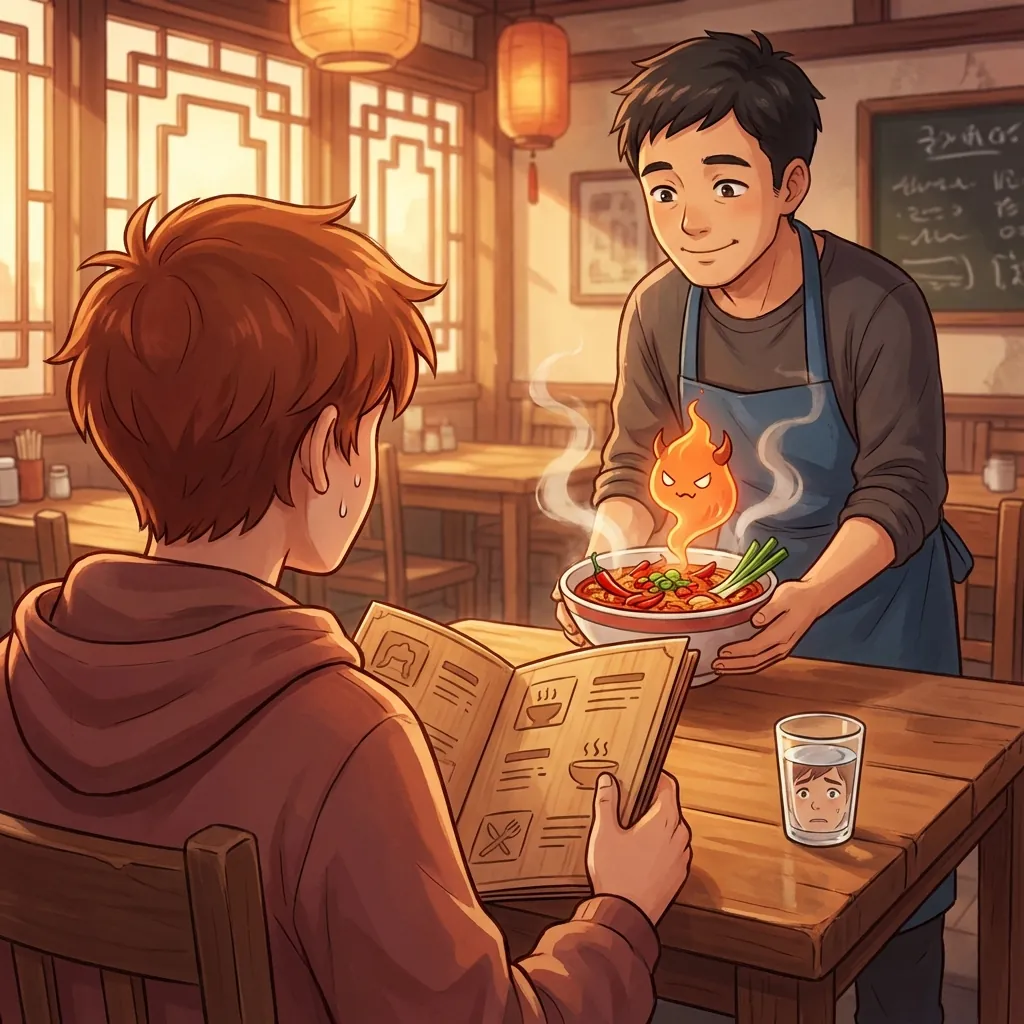
The biggest mistake beginners make is assuming that 微辣 (wēi là) means "mild" in the Western sense. It does not.
Wēi Là literally translates to "micro spicy." However, in a Sichuan kitchen, this is interpreted as: "The customer is weak, but I cannot insult my ancestors by serving flavorless food. I will only put one scoop of chili oil instead of three."
If you have zero tolerance for heat, Wēi Là is not your friend. It is a trap.
The Standard Spice Scale
To navigate a Chinese menu, you need to understand the four standard tiers of heat. Note that these are relative to the region. "Medium" in Shanghai is "Not Spicy" in Chongqing.
1. Bù Là (不辣) - Not Spicy
This is the theoretical zero. You are asking for no chili peppers.
Note: Even if you say 不辣, your food might still have a slight kick. This is the "Wok Transfer" effect. If the chef just finished stir-frying a pound of chilies for the previous table, your "non-spicy" broccoli is getting cooked in that same spicy oil residue.
2. Wēi Là (微辣) - Mildly Spicy
As mentioned, this is the danger zone. Use this if you enjoy spicy food but don't want to sweat through your shirt. Do not use this if you think black pepper is spicy.
3. Zhōng Là (中辣) - Medium Spicy
This is the standard for locals. Expect red oil, dried chilies, and a significant endorphin rush.
4. Tè Là (特辣) - Extra Spicy
Sometimes called Biàntài (abnormal/perverted) in slang contexts. This is for thrill-seekers. It usually involves a pile of chilies so high you have to dig for the actual meat.
| Simplified | Traditional | Pinyin | Meaning | Note |
|---|---|---|---|---|
| 不辣 | 不辣 | Bù là | Not spicy | The safest bet, but not 100% guaranteed. |
| 微辣 | 微辣 | Wēi là | Mildly spicy | Actually quite hot in Sichuan. |
| 中辣 | 中辣 | Zhōng là | Medium spicy | The local standard. |
| 特辣 | 特辣 | Tè là | Extra spicy | Painful. |
Decoding the Burn: Ma vs. La
Before you order, you need to distinguish between the two types of heat.
The 'La' (辣)
This is the heat you know. It comes from chili peppers. It burns your tongue and throat.
The 'Ma' (麻)
This is unique to Sichuan cuisine (and Málà flavor profiles). It comes from the Sichuan peppercorn (Huājiāo). It doesn't burn; it vibrates. It creates a tingly, numbing sensation that feels like licking a 9-volt battery.
If you can handle heat but hate the feeling of your lips falling asleep, you need to ask to remove the Ma, not the La.
- To remove the numbing:
- 不要麻 (Bù yào má) - I don't want numbing.
Survival Phrases for the Spice-Intolerant
If you simply cannot eat spicy food, 不辣 (Bù là) is sometimes ignored by chefs who think they know better. You need stronger vocabulary.
The 'Secret Code': Qīngdàn
The most effective way to get truly non-spicy food is to use the word Qīngdàn (Light/Bland).
This word signals a specific dietary preference for food that is light on oil and strong seasoning. It tells the chef you want something healthy and simple, rather than just being "afraid" of spice.
我们要吃清淡一点的。(Wǒmen yào chī qīngdàn yīdiǎn de.) We want to eat something light/mild.
The 'Nuclear Option': Miǎn Là
If you have a serious sensitivity, use Miǎn Là (Exempt from spice). This sounds more formal and strict than just saying "I don't want spice."
这个菜可以免辣吗?(Zhège cài kěyǐ miǎn là ma?) Can this dish be made completely without spice?
The 'Rinse' Trick
If you accidentally order something too spicy, or if you are eating family-style with people who love heat, ask for a bowl of water to rinse your food.
可以给我一碗开水吗?我要过一下水。(Kěyǐ gěi wǒ yī wǎn kāishuǐ ma? Wǒ yào guò yīxià shuǐ.) Can you give me a bowl of boiled water? I want to rinse [the food].
Quick Takeaways
Ordering food in China requires confidence. Before you call the waiter, decide on your strategy.
- Safety First: If you can't handle heat, say "Miǎn Là" (免辣) or ask for "Qīngdàn" (清淡) dishes.
- The Trap: Avoid "Wēi Là" (微辣) in Sichuan restaurants unless you are ready to sweat.
- The Numbness: Remember that "Má" (麻) is different from "Là" (辣). You can have one without the other.
Next time you see a bright red bowl of oil heading your way, check if there are peppercorns floating in it. If there are, buckle up.