Standing in the middle of Shanghai Hongqiao Station is a humbling experience. It is not just a station; it is a small city with its own ecosystem, fueled by instant noodles and punctuality. If you are standing there clutching a red or blue paper slip, trying to figure out how to read chinese train ticket seat gate car number combinations before your train leaves in eight minutes, this guide is for you.
First, a reality check: That paper in your hand might not even be a ticket.
The Era of the "Ghost" Ticket
If you learned Chinese five years ago, you were probably taught to read the blue magnetic tickets. Throw that knowledge out. China has fully transitioned to E-tickets (电子客票).
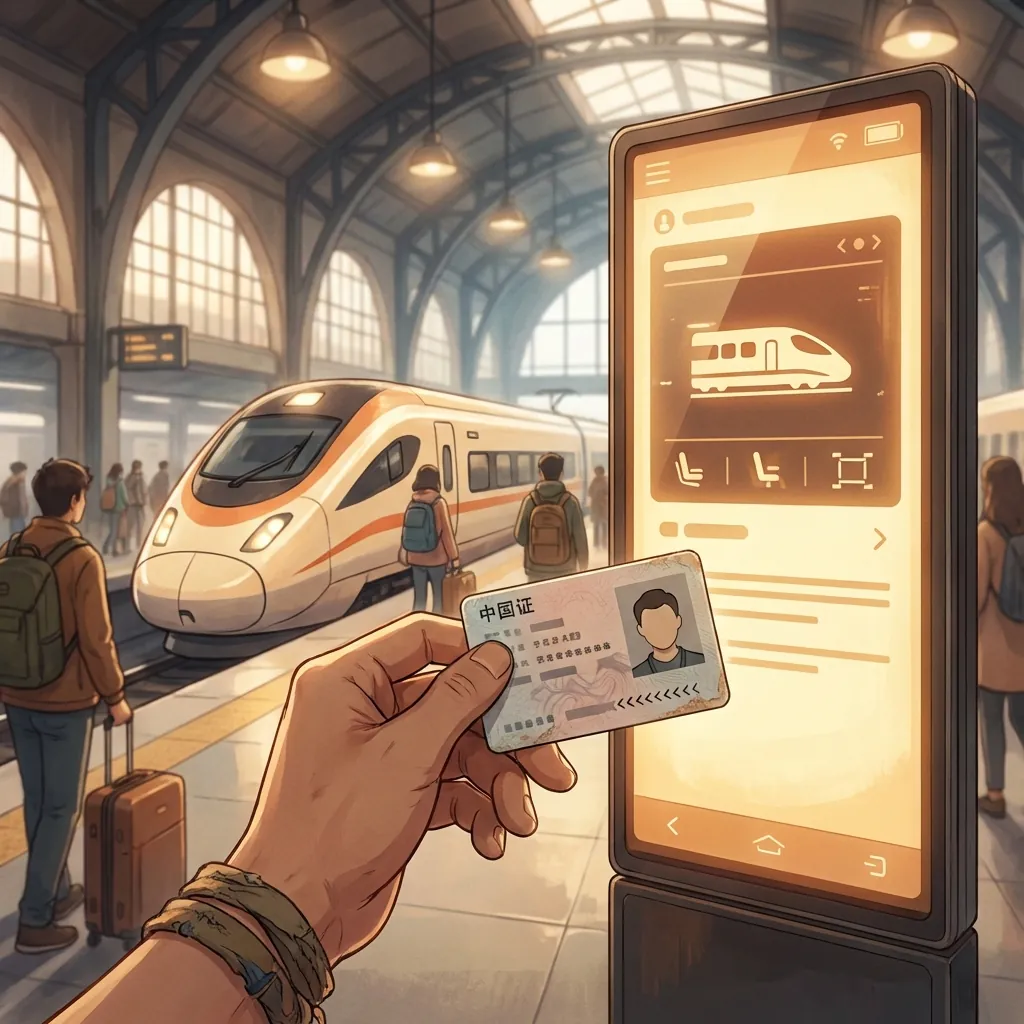
Your "ticket" is your ID (Passport or Chinese ID card). You scan your physical passport at the gate to enter.
So, what is that paper slip you printed at the kiosk? It is usually a Reimbursement Voucher, known as 报销凭证. It exists solely for business travelers to claim expenses.
Why does this matter? Because the reimbursement voucher often lacks real-time info like gate changes, and specifically says "Cannot be used for travel" in fine print. However, it does contain your seat info, so let's decode it.
Decoding the Paper (or App Screenshot)
Whether you are looking at a screenshot from the Trip.com / 12306 app or a printed slip, the layout follows a strict logic.
1. The Train Number
Found at the top center. It usually starts with a letter.
- G (Gāotiě): 300km/h+ (The fastest ones).
- D (Dòngchē): ~250km/h.
- C (Chéngjì): Intercity commuter trains.
2. The Station Names
Top left and right. This is where your directional vocabulary is vital. If you end up at Beijing South when you should be at Beijing West, you will miss your train.
北京南 (Beijing South) 上海虹桥 (Shanghai Hongqiao)
Check these against your map app immediately. If you need a refresher on cardinal directions, read my guide on Asking Directions: North, South, East, West.
3. The Date and Time
Under the station names. Chinese format is strictly Year - Month - Day.
2026年02月09日 14:30 开
Warning: The time listed is the departure time. The gates usually close (stop check-in) exactly 3 to 5 minutes before this time. Do not aim to arrive at the gate at 14:30. You will be watching the train leave without you.
4. Car and Seat (The Most Important Bit)
This is the data you need to position yourself on the platform. It typically looks like this:
05车 12F号
Here is the breakdown:
- 车厢 (Carriage/Car): In this example, you are in Car 05. On the platform floor, look for the number "5".
- 号 (Number): This indicates your seat. 12F.
Pro Tip: In Second Class (二等座), seating usually follows an ABC - DF configuration.
- A/F: Window seats.
- C/D: Aisle seats.
- B: The dreaded middle seat (only exists on the 3-seat side).
The Gate vs. The Platform
This is where 90% of foreigners get confused.
- 检票口 (Check-in Gate): This is a number (e.g., 14A or 14B) inside the massive waiting hall. You queue here first.
- 站台 (Platform): This is downstairs where the train physically sits.
You cannot go to the platform until the gate opens (usually 15 mins before departure).
If you see a long line of people scanning their ID cards at a turnstile, that is the Check-in Gate. If you are worried about the scanning process, I wrote a breakdown of the anxiety involved in The Scan vs Be Scanned Anxiety Guide.
Essential Vocabulary Cheat Sheet
When you are staring at the big LED board, look for these words.
| Simplified | Traditional | Pinyin | Meaning | Note |
|---|---|---|---|---|
| 检票口 | 檢票口 | jiǎn piào kǒu | Check-in Gate | Go here first |
| 站台 | 月台 | zhàn tái | Platform | Go here after scanning |
| 正在检票 | 正在檢票 | zhèng zài jiǎn piào | Check-in Now | Run! |
| 停止检票 | 停止檢票 | tíng zhǐ jiǎn piào | Stop Check-in | You missed it |
| 二等座 | 二等座 | èr děng zuò | Second Class | Standard seats |
| 商务座 | 商務座 | shāng wù zuò | Business Class | The expensive lay-flat seats |
Navigating the Platform Floor
Once you pass the gate and go down the escalator, you will see colored numbers pasted on the floor. These mark where the doors for each Car (车) will open.
- Your ticket says 05车.
- The digital screen above the platform says "Blue" (or another color).
- Find the Blue 5 on the floor and stand in line there.
If you ignore this and just stand anywhere, you will have to sprint with your luggage through the crowded train interior, apologising to everyone with a polite Buhaoyisi.
Summary
- Ignore the paper for boarding; use your Passport/ID.
- Find your Gate (检票口) in the main hall first.
- Gate closes 5 mins early. This is not a suggestion.
- Match your Car (车) number to the floor markings downstairs.
Travel in China is remarkably efficient once you know the code. Just don't block the aisle while you figure it out.