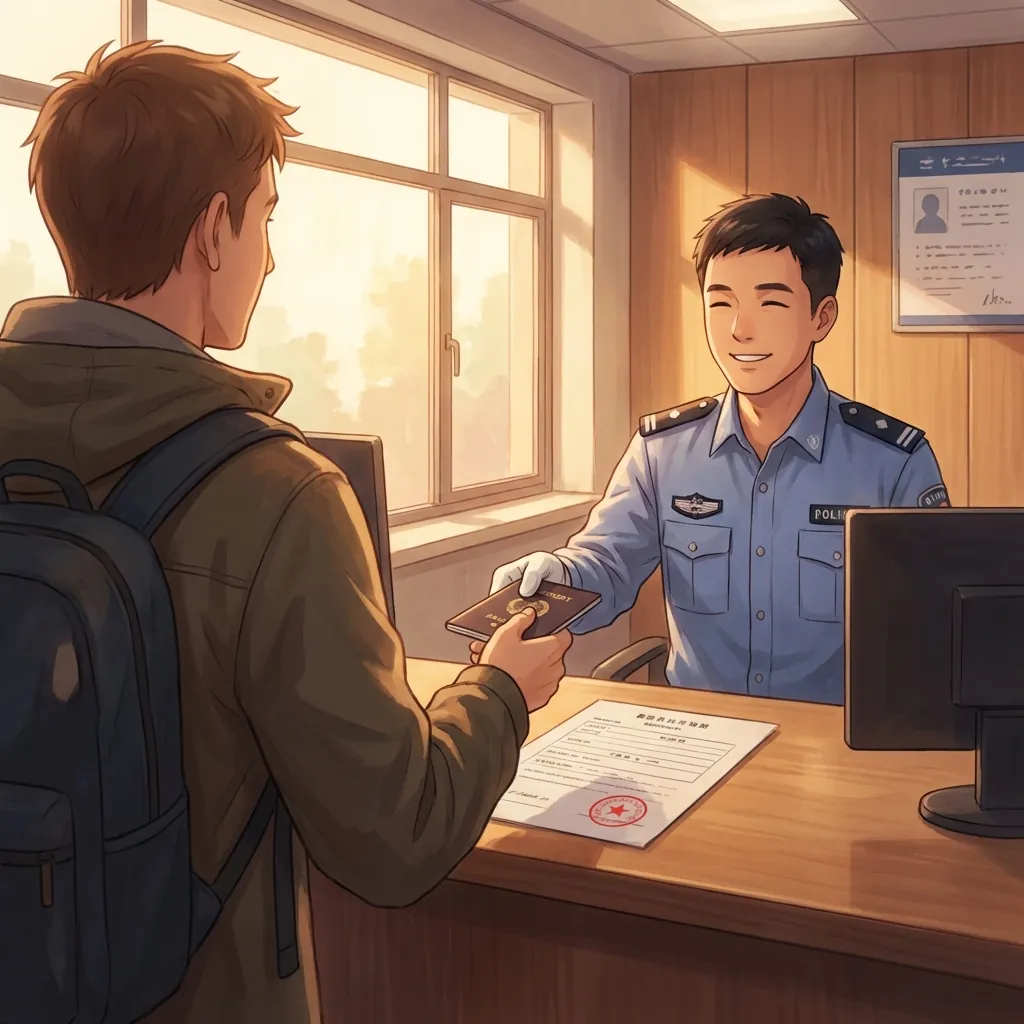
You have just landed in China. You have your luggage, your VPN is struggling to connect, and you just want to sleep. But before you get too comfortable, there is one bureaucratic hurdle that trips up more new arrivals than anything else: the police registration.
If you are looking for the hotel police registration china foreigner rules explained, the short version is this: The Chinese government must know exactly where you are sleeping every single night. If you are staying at a hotel, they scan your passport and handle it for you. If you are staying in an Airbnb, a private apartment, or a friend's couch, the responsibility falls 100% on you.
Here is how to survive the Pàichūsuǒ (local police station) and get that critical piece of paper.
The "Red Stamp" Reality
Technically called the "Registration Form of Temporary Residence" (临时住宿登记表), this flimsy sheet of paper is arguably more important than your lease.
Without it, you cannot:
- Extend your visa or apply for a Residence Permit.
- Open a bank account.
- Register for a driver's license.
- Sometimes, even sign up for home internet.
It is the foundational document of your legal existence in China. Do not lose it.
The 24-Hour Rule
The law states you must register within 24 hours of arriving at your accommodation in urban areas (72 hours in rural areas). This applies every time you enter the country and every time you move to a new apartment.
If you are staying at a hotel, the front desk scans your passport. That scan goes directly to the Public Security Bureau (PSB). You are done.
If you rent an apartment or stay with a friend, you must physically go to the police station or use an online app to register. If you don't, you risk a fine (Fákuǎn) of up to 2,000 RMB, though usually, it is just a warning if you are honest about it.
The Paperwork Checklist
Before you head out, gather these documents. Do not expect the police to make copies for you.
- Original Passport (Hùzhào)
- Passport Copies (Photo page + Visa page + Entry stamp page)
- Lease Agreement (租赁合同)
- Landlord's ID Copy (房东身份证)
- Property Deed Copy (Property Deed)
Negotiating with the Landlord
This is often harder than the police visit itself. Many landlords (Fángdōng) are wary of giving you their personal ID or property deed because they are afraid of paying taxes on the rental income.
You need to be firm but polite. Explain that you cannot live there legally without these documents.
The Script
Here is how to ask for the documents without causing a fight. Notice we don't use aggressive sentence connectors; keep it simple.
You:
-
你好,我去派出所登记需要您的身份证复印件和房产证复印件。
- (Nǐ hǎo, wǒ qù pàichūsuǒ dēngjì xūyào nín de shēnfènzhèng fùyìnjiàn hé fángchǎnzhèng fùyìnjiàn.)
- Hi, I need a copy of your ID and property deed to register at the police station.
Landlord (Hesitant):
-
以前的房客都不需要啊。
- (Yǐqián de fángkè dōu bù xūyào a.)
- Previous tenants didn't need that.
You:
-
这是法律规定。如果不登记,我会被罚款,签证也会有问题。
- (Zhè shì fǎlǜ guīdìng. Rúguǒ bù dēngjì, wǒ huì bèi fákuǎn, qiānzhèng yě huì yǒu wèntí.)
- It is the law. If I don't register, I will be fined, and my visa will have issues.
If they are still stubborn, assure them you are only showing it to the police, not the tax bureau.
Hai vs Ye is useful here if you want to add "I also need..." but keep it simple for now.
Vocabulary: Decoding the Form
Whether you fill it out on a WeChat mini-program or on paper, the fields are standard. Here is your cheat sheet.
| Simplified | Traditional | Pinyin | Meaning | Note |
|---|---|---|---|---|
| 姓名 | 姓名 | Xìngmíng | Full Name | Write exactly as shown in passport |
| 国籍 | 國籍 | Guójí | Nationality | |
| 证件号码 | 證件號碼 | Zhèngjiàn hàomǎ | ID Number | Your passport number |
| 入住日期 | 入住日期 | Rùzhù rìqī | Move-in Date | Match your lease or arrival date |
| 房主 | 房主 | Fángzhǔ | Homeowner | The landlord's name |
| 派出所 | 派出所 | Pàichūsuǒ | Police Station | Local precinct name |
The Visit: What to Expect
Walk into the station. Look for the counter that says 户籍 (Hùjí - Household Registration) or 外籍人 (Wàijírén - Foreigners).
Don't be intimidated by the uniforms. The officers doing this paperwork are usually administrative staff.
Useful phrase when you walk in:
你好,我是来办临时住宿登记的。(Nǐ hǎo, wǒ shì lái bàn línshí zhùsù dēngjì de.) Hi, I am here to handle the temporary residence registration.
They will look at your papers, type furiously for five minutes, and print out a sheet with a red stamp. Check the spelling of your name immediately. If it is wrong, fix it now. It is much harder to fix later.
Troubleshooting
What if I am late? If you go a week later, just apologize. Use 不好意思 (Bù hǎoyìsi). Usually, they will just scold you and process it. If you are months late, prepare to pay a fine. See Duibuqi vs Buhaoyisi to know which apology to use (hint: start with bù hǎoyìsi, move to duìbuqǐ if they get angry).
Can I do this online? In Tier 1 cities (Shanghai, Beijing, Shenzhen), yes. There are WeChat mini-programs. Ask your colleagues or landlord for the QR code. However, these systems verify your location data and often reject photos of documents if they aren't perfectly lit. The physical station is often faster if the app fails.
I am staying with a friend. Your friend effectively becomes your "landlord." You need their ID and property deed. This is why many people just book a cheap hotel for a night or two when they first arrive to get the initial registration done automatically before sorting out private housing.
Once you have that paper, take a picture of it. Save it. You have officially checked in.