You are sitting in a restaurant in Beijing. You are hungry. You have made eye contact with the server three times. You even gave a little polite nod.
Nothing is happening.
In London or New York, this is how it works. You wait for the server to "hover" near you, or you catch their gaze, and they drift over. In China, this approach will leave you starving.
Here is the hard truth: Chinese service is on-demand, not proactive.
If you want water, napkins, or the bill, you have to ask for it. And you usually have to do it loudly. I know this goes against every "polite" bone in your body, but trust me on this one. If you don't speak up, they assume you are happy and want to be left alone.
The Magic Word: Fuwuyuan
The standard, default, works-99%-of-the-time word you need is 服务员.
Literally, it just means "Attendant" or "Service Staff." It is gender-neutral and professional. It is not an insult.
服务员 (Fú wù yuán)
Waiter / Waitress
The mistake most learners make isn't the pronunciation. It's the tone. You cannot say this like a question ("Fuwuyuan?"). You are not asking if they exist. You are summoning them.
It needs to be a statement. Flat and projected.
- You: 服务员!点菜! (Fú wù yuán! Diǎn cài!) - Waiter! Order food!
- Server: 来了! (Lái le!) - Coming!
The Volume Game (Why You Are Failing)
If you say 服务员 at a conversational volume, no one will hear you.
Chinese restaurants prize an atmosphere called 热闹 (Rè nao). It translates to "Hot and Noisy." A quiet restaurant in China is suspicious; it implies the food is bad or the place is dead.
Because the background noise is high, your volume must be higher. You are not shouting at the waiter in anger; you are projecting your voice to the waiter across a noisy room.
The Golden Rule: If you feel slightly embarrassed by how loud you are being, you are probably doing it right.
The Taiwan Trap (Read Before Traveling)
If you cross the strait to Taiwan, you need to delete 服务员 from your vocabulary immediately.
In Taipei, shouting 服务员 sounds incredibly weird. It feels stiff, overly formal, and distinctly "Mainland." It marks you as a tourist instantly.
Instead, Taiwanese service culture is softer. You should catch the server's eye and say:
不好意思 (Bù hǎo yì si)
Excuse me / Sorry to bother you
(If you want a deep dive on why this phrase is so versatile, check out my guide on Buhaoyisi vs Duibuqi).
If you really need a noun to call them, use generic titles:
- For women: 小姐 (Xiǎo jiě) - Miss
- For men: 先生 (Xiān sheng) - Sir
Advanced & Risky: Meinv and Shuaige
You might hear locals using different words. In casual dining spots, think late-night barbecue joints, noodle shops, or hot pot places, it is very common to hear customers calling the staff "Beauty" or "Handsome."
美女 (Měi nǚ)
Beauty (used for any female waitress)
帅哥 ( Shuài gē)
Handsome (used for any male waiter)
Warning: This is contextual.
- Street food / Casual: Perfectly fine. It's friendly and breaks the ice.
- High-end steakhouse: Do not do this. You will look like a creep.
- The Office Canteen: Totally normal.
If you are a beginner, stick to 服务员. It never fails. But if you are feeling confident at a loud noodle stall, throwing out a 美女 will make you sound like a local.
The Silent Revolution: QR Codes
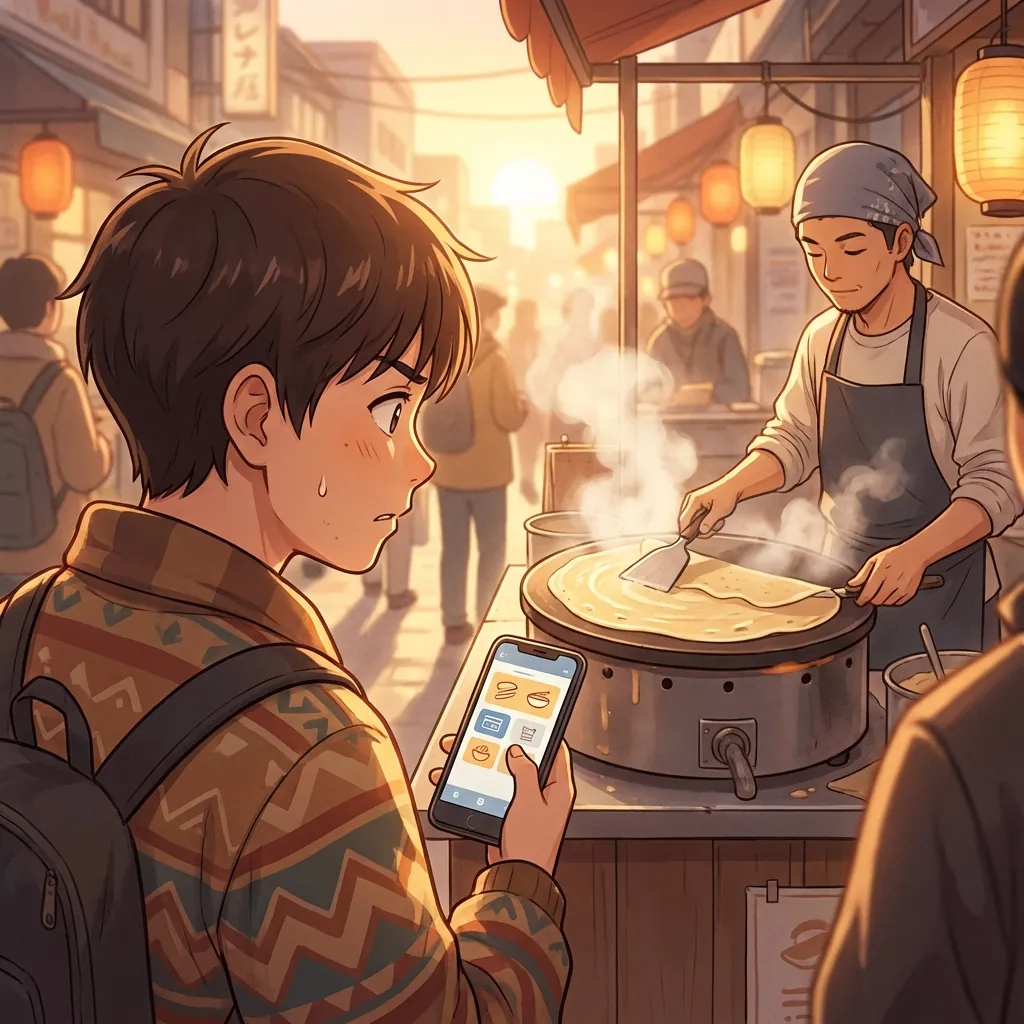
I have to mention this because it is 2024. In Tier 1 cities like Shanghai, Beijing, and Shenzhen, you might not need to talk to a human at all.
Most tables now have a QR code stuck to the corner. You scan it with WeChat or Alipay, order on your phone, and pay on your phone. The staff simply brings the food.
If the staff points at the table and mumbles something, they are probably telling you to scan.
扫码点餐 (Sǎo mǎ diǎn cān)
Scan code to order food
Getting the Bill
You have finished eating. You want to leave. Do not wait for the check to appear. It will never come. In Chinese culture, bringing the check before it is asked for is rude; it implies the restaurant is kicking you out.
You need to shout again.
服务员,买单! (Fú wù yuán, mǎi dān!)
Waiter, the bill!
If it is too loud to speak, the universal gesture works: raise your hand and make a scribbling motion in the air like you are signing a receipt. They will understand.
Quick Vocabulary Recap
Here is your cheat sheet for surviving a Chinese meal.
| Simplified | Traditional | Pinyin | Meaning | Note |
|---|---|---|---|---|
| 服务员 | 服務員 | Fú wù yuán | Waiter / Staff | Standard in Mainland China. |
| 不好意思 | 不好意思 | Bù hǎo yì si | Excuse me | Standard in Taiwan. |
| 买单 | 買單 | Mǎi dān | Pay the bill | Use at the end of the meal. |
| 美女 | 美女 | Měi nǚ | Beauty | Casual slang for waitresses. |
| 帅哥 | 帥哥 | Shuài gē | Handsome | Casual slang for waiters. |
| 扫码 | 掃碼 | Sǎo mǎ | Scan code | For QR code ordering. |