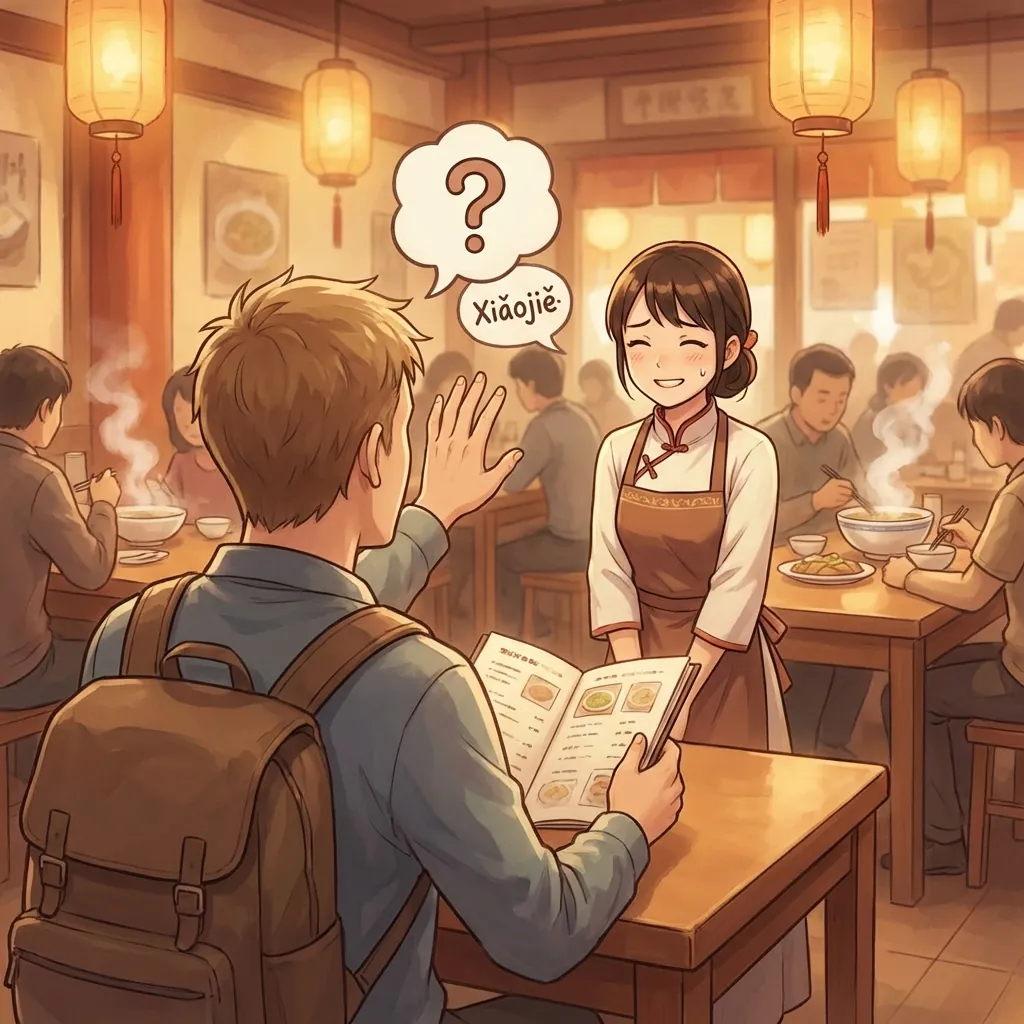
If you open almost any beginner Chinese textbook, you will learn that the word for "Miss" or "Young Lady" is Xiǎojiě 小姐. It seems polite, but understanding the nuance of calling waiter xiaojie vs fuwuyuan offensive meaning is critical. You might think it is the perfect way to get attention, but in many places, it is a mistake.
Then you travel to Beijing or Shanghai. You sit down at a restaurant, wave your hand, and confidently shout, "Xiǎojiě!"
The restaurant goes quiet. The server looks annoyed, or worse, embarrassed. You have just stumbled into one of the most common cultural pitfalls for Mandarin learners.
While the dictionary definition is innocent, the street usage is complicated. Knowing the difference is critical to saving face (and getting your food). Here is why you should probably drop this word from your vocabulary in Mainland China, and exactly what to say instead.
The Trap: How 'Miss' Became an Insult
In the dictionary, 小姐 (xiǎojiě) simply means "Miss." It is composed of 小 (small/young) and 姐 (sister/lady).
However, during the economic boom of the 1990s and early 2000s in Mainland China, the term underwent a massive linguistic shift. It became the primary euphemism for sex workers, specifically those working in KTVs, bars, and massage parlors.
Because of this association, calling a professional waitress "Xiǎojiě" can sound like you are implying she works in that other industry. It can feel dismissive, patronizing, or just plain sleazy.
Is it always offensive? No. In high-end hotels or very formal business contexts where you are using it with a surname (e.g., "Li Xiǎojiě"), it is still acceptable. But for grabbing a stranger's attention in a noodle shop? It is a high-risk move.
The Regional Rulebook: Where is it Safe?
Mandarin usage varies wildly by geography. Before you permanently delete this word, check where you are standing.
Mainland China: Avoid
If you are in Beijing, Shanghai, or anywhere in the PRC, do not use it as a standalone title for strangers. It creates unnecessary awkwardness.
Taiwan: Safe
In Taiwan, 小姐 has zero negative baggage. It is the standard, polite way to address a waitress, a female clerk, or a lady on the street. If you yell "Fúwùyuán" (the Mainland standard) in Taipei, people might stare at you because you sound like a communist era robot.
Singapore & Malaysia: Safe
Similar to Taiwan, it generally retains its original polite meaning here.
Better Alternatives for Mainland China
If you are on the Mainland, you need replacements. Luckily, there are terms that are not only safer but will make you sound much more local.
1. Fúwùyuán (The Gold Standard)
This is the catch-all term for "Server" or "Waiter." It is gender-neutral, professional, and carries zero risk of offense. It is the most robust solution for how to call a waiter in Chinese.
Example:
服务员,点菜!Fúwùyuán, diǎn cài! Waiter, (we are ready to) order!
Check the tones here: Fúwùyuán.
2. Měinǚ / Shuàigē (The 'Flattery' Method)
This surprises many Westerners. You can literally call a waitress "Beauty" (美女) or a waiter "Handsome Guy" (帅哥).
In the West, this would be catcalling. In China, it is transactional flattery. It is used everywhere from bubble tea shops to hot pot restaurants. It softens the interaction and makes you sound friendly and casual.
Example:
美女,请问洗手间在哪里?Měinǚ, qǐngwèn xǐshǒujiān zài nǎlǐ? Miss (Beauty), may I ask where the restroom is?
3. Xiǎojiějie (The Trendy Choice)
If 小姐 is the risky old term, Xiǎojiějie 小姐姐 is the safe, modern update. Literally "Little Elder Sister," it became popular through internet culture (Douyin/TikTok).
It is slightly cutesy, so you generally use it for women younger than you or around your age. It removes the "professional" distance of Fúwùyuán and the "sleazy" risk of Xiǎojiě.
4. Āyí (The Age Factor)
We have discussed this in our guide on addressing strangers like Ayi and Shushu. If the staff is significantly older, 阿姨 (Āyí - Auntie) works well, especially in small, family-run eateries.
Quick Cheat Sheet
Here is your survival guide for the next time you need chopsticks.
| Term | Pinyin | Literal Meaning | Usage (Mainland) | Usage (Taiwan) |
|---|---|---|---|---|
| 小姐 | xiǎojiě | Miss | Avoid (Risky) | Standard (Polite) |
| 服务员 | fúwùyuán | Waiter/Server | Best (Professional) | Rare (Sounds stiff) |
| 美女 | měinǚ | Beauty | Good (Casual) | Acceptable (Casual) |
| 帅哥 | shuàigē | Handsome Guy | Good (Casual) | Acceptable (Casual) |
| 小姐姐 | xiǎojiějie | Little Sister | Trendy (Friendly) | Less common |
Summary
Language is about context. If you are reading old textbooks, you might think you are being a gentleman by calling someone Xiǎojiě. In reality, you might be making everyone at the table cringe.
When in doubt on the Mainland, stick to Fúwùyuán. It might not be fancy, but it never fails.


