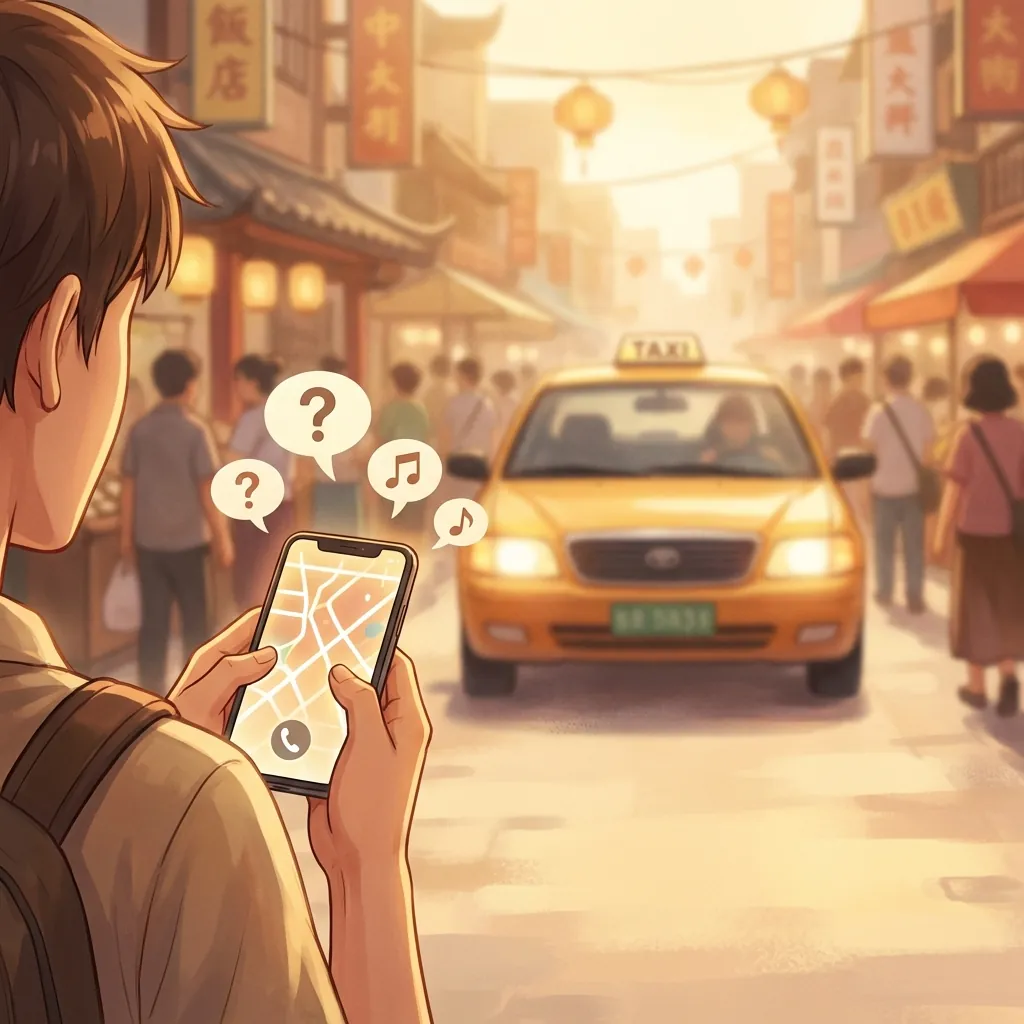
You are standing on a curb in Shanghai. You just booked a car. The app says he is two minutes away. Suddenly, your phone rings.
Your heart rate spikes. You know who it is. You know you have to pick up. And you know exactly what’s going to happen: a rapid-fire stream of loud Mandarin that sounds like a scolding.
If you are searching for chinese taxi driver calling what to say, you are likely in this exact moment of panic. Breathe. This guide is your script for surviving the pickup without canceling the ride.
Culture Check: Why Is He Shouting?
First, let’s reframe the situation. You pick up the phone and hear:
Driver: 喂?你在哪里?! (Wéi? Nǐ zài nǎlǐ?!)
It sounds aggressive. It sounds like he hates you. He doesn't.
Here is the reality of the Shīfu (Driver):
- He is on speakerphone: He is driving. His phone is likely mounted on the dashboard, and he is shouting to be heard over the engine.
- The windows are down: Wind noise is deafening at 60 km/h.
- Efficiency is king: He isn't calling to chat. He wants to find you, get you in the car, and start the meter. In Chinese service culture, brevity isn't rude; it's professional.
The Script: Answering the Call
The driver only wants to know one thing: Your precise location. GPS in high-density Chinese cities is notoriously drift-prone. He sees a pin, but he doesn't see you.
The Trigger Question
Listen for this specific phrase. It is the most common opener:
你在哪里?(Nǐ zài nǎlǐ?) Where are you?
Sometimes they shorten it to just 在哪儿? (Zài nǎr?).
Strategy 1: The Landmark Method
To answer, use the standard Chinese location sentence structure: Subject + Zài + Location.
The most useful landmarks are gates (门 - mén). If you are at a mall, hotel, or compound, figure out which gate you are standing at.
- Driver: 你在哪里?
- You: 我在北门。
我在... (Wǒ zài...) + [Location] I am at... [Location]
If you don't know your North from South, check your map app or look for signs. Knowing your cardinal directions is a superpower here.
Strategy 2: The "Next To" Method
If you aren't at a gate, find a distinct building or brand. Starbucks, KFC, or a bank work best. Use the word Pángbiān (Next to).
- You: 我在星巴克旁边。
我在 (Wǒ zài) + [Landmark] + 旁边 (pángbiān) I am [Landmark] next-to.
Note the grammar: "Next to Starbucks" becomes "Starbucks Next-to." If you mess this up, he might still understand, but sticking to the correct order helps.
Essential Vocabulary for Pickups
Memorize these. They are your coordinates.
| Simplified | Traditional | Pinyin | Meaning | Note |
|---|---|---|---|---|
| 师傅 | 師傅 | Shīfu | Driver / Master | Polite address for the driver. |
| 门口 | 門口 | Ménkǒu | Gate / Entrance | Generic. "I am at the entrance." |
| 北门 | 北門 | Běimén | North Gate | Common pickup point. |
| 南门 | 南門 | Nánmén | South Gate | |
| 旁边 | 旁邊 | Pángbiān | Next to | Used after the noun (e.g., KFC pángbiān). |
| 马路对面 | 馬路對面 | Mǎlù duìmiàn | Across the street | Lit. "Road opposite side." |
| 这里 | 這裡 | Zhèlǐ | Here | Useful if he waves at you: "Wǒ zài zhèlǐ!" |
Survival Mode: When You Just Can't Explain
Sometimes, despite your best 我在北门, the driver starts asking complicated questions about roadworks or one-way streets. The panic returns.
If you feel the conversation slipping away, abort the call safely.
The "Hang Up and Chat" Tactic
Technology is better than struggling through a bad connection. If you can't communicate verbally:
- Say this phrase loudly and clearly:
对不起,我听不懂。
(Duìbuqǐ, wǒ tīng bù dǒng.) Sorry, I don't understand.
- Hang up.
- Open the Didi (or Alipay) app.
- Click the Message/Chat icon.
- Type in English: "I am standing in front of the Starbucks."
The app has a built-in auto-translate feature. The driver will see your message in Chinese text and can reply in text. This removes the accent barrier, the wind noise, and the anxiety.
This isn't rude; it is actually helpful for the driver because now he has a written record of where you are.
Summary
Don't let a ringing phone scare you into walking home.
- Expect the volume. He isn't angry.
- Listen for "Zài nǎlǐ".
- Reply with "Wǒ zài + [Gate/Landmark]".
- If stuck, hang up and type.
Next time that phone rings, take a breath, channel your inner local, and tell him exactly which Ménkǒu (Gate) you are standing at.