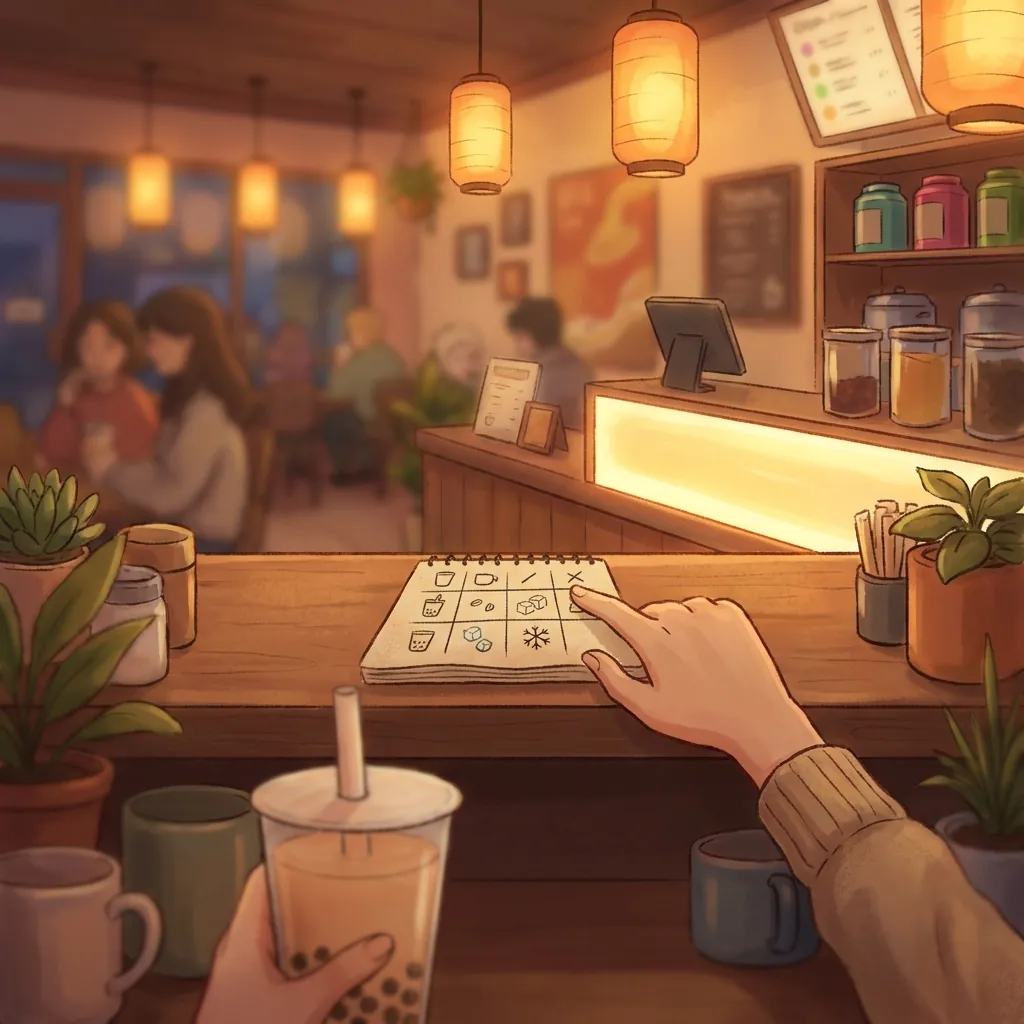
You stand at the counter. The menu is a chaotic wall of text. The cashier is staring at you, hand hovering over the POS system. You panic and just say “the standard one,” only to end up with a drink that is 100% sugar and filled to the brim with ice, giving you three sips of actual tea before it’s gone.
Ordering bubble tea (boba) in Chinese does not have to be a gamble. It is a precise science. Unlike Western coffee shops where modifications are often seen as annoying, bubble tea shops expect you to customize. If you do not specify, you are getting the “house standard,” which is usually designed for a teenage palate with a high tolerance for glucose.
Here is the complete matrix to getting exactly what you want, whether you are in Taipei, Shanghai, or a Chinatown in London.
Axis 1: The Sweetness Spectrum
Most shops operate on a percentage scale. However, “100%” at a bubble tea shop is not the same as 100% sweetness in a latte. It is significantly more intense.
Here is the breakdown of the sweetness vocabulary, or 甜度 (tián dù).
| Simplified | Traditional | Pinyin | Percentage | Meaning | Note |
|---|---|---|---|---|---|
| 全糖 | 全糖 | Quán táng | 100% | Full Sugar | Usually too sweet for adults. |
| 少糖 | 少糖 | Shǎo táng | 70% | Less Sugar | The “safe” sweet option. |
| 半糖 | 半糖 | Bàn táng | 50% | Half Sugar | The true standard balance. |
| 微糖 | 微糖 | Wēi táng | 30% | Micro Sugar | Tea flavor dominates. |
| 无糖 | 無糖 | Wú táng | 0% | No Sugar | Pure tea/milk taste. |
The 50% Rule
If you are unsure, start with 半糖 (bàn táng). In Asian metropolises, the “Standard” (100%) is often shockingly sweet to uninitiated palates. 50% allows the aroma of the tea to actually exist alongside the sugar.
Axis 2: Temperature & Texture
The second variable is ice, or 冰块 (bīng kuài). This determines not just temperature, but volume and dilution.
| Simplified | Traditional | Pinyin | Level | Meaning | Note |
|---|---|---|---|---|---|
| 正常冰 | 正常冰 | Zhèngcháng bīng | 100% | Regular Ice | Maximum dilution over time. |
| 少冰 | 少冰 | Shǎo bīng | 70% | Less Ice | Cold but less watery finish. |
| 微冰 | 微冰 | Wēi bīng | 30% | Little Ice | Just enough to keep it cool. |
| 去冰 | 去冰 | Qù bīng | 0% | No Ice | Cold liquid, no cubes. |
| 热 | 熱 | Rè | - | Hot | Good for ginger/jujube teas. |
Warning: 去冰 (qù bīng) literally means “remove ice.” The drink will still be cold (chilled in the shaker), but there will be no floating ice cubes in your cup. This is the pro move for getting maximum beverage volume.
The Interaction Matrix: Where Sugar Meets Ice
Most guides treat sugar and ice as independent variables. They are not. They interact. If you ignore this dynamic, your drink will taste “off” even if you use the correct vocabulary.
1. The Dilution Dynamic
If you order Regular Ice, your drink effectively dilutes itself over 20 minutes. A 100% sugar drink might taste like a 70% sugar drink by the time you finish it.
If you order No Ice (去冰), there is no dilution. A 50% sugar drink with no ice will taste sweeter than a 50% sugar drink with ice.
The Adjustment: If you order No Ice, consider dropping your sugar level one step lower than usual.
2. The Temperature Masking Effect
Cold numbs your taste buds. This is why melted ice cream tastes sickeningly sweet compared to frozen ice cream.
- Cold Drink: You might need 50% sugar to feel satisfied.
- Hot Drink: That same 50% sugar will taste overwhelmingly sweet because the heat amplifies the perception of sugar.
The Adjustment: If ordering a hot (热) drink, always downgrade your sugar level. If you usually drink 50% cold, order 30% hot.
3. The Base Tea Offset
Not all base teas react to sugar the same way.
- Milk Teas: The fat in the milk/creamer coats the tongue, dampening sweetness. You can handle higher sugar levels (50-70%).
- Fruit Teas: These often contain fruit jams or syrups that have intrinsic sugar. A 30% sugar fruit tea is often sweeter than a 50% sugar milk tea.
Ordering Like a Local
You do not need complex grammar. You just need to stack the variables. If you need a refresher on counting, check the rules for saying two instead of two.
The structure is: [Drink Name] + [Sugar Level] + [Ice Level].
Coffee shops use a similar stacking pattern, but milk substitutions work best as a separate question. If you need oat or soy milk, use the short sequence in Miaozi's guide to ordering a plant-milk coffee in Chinese.
Here is a typical interaction. Note the bullet points for the dialogue flow.
- Staff: 你要喝什么? (Nǐ yào hē shénme? / What do you want to drink?)
- You: 一杯珍珠奶茶。 (Yī bēi zhēnzhū nǎichá. / One pearl milk tea.)
- Staff: 甜度冰块? (Tiándù bīngkuài? / Sweetness and ice?)
- You: 半糖,少冰。 (Bàn táng, shǎo bīng. / Half sugar, less ice.)
If you are visiting a friend’s house and bringing boba, knowing these preferences is key. It shows the same attention to detail as knowing which fruits to bring as a gift.
Regional Nuances
In Taiwan, customization is religion. If you do not specify, they will ask. In mainland China, the vocabulary is largely the same, though you might hear 常温 (cháng wēn) for “room temperature” more often than in other regions.
The Health Matrix: The Calorie Trap
A standard milk tea with pearls can easily hit 500-600 calories. Here is the harsh reality of the “Zero Sugar” order:
If you order 0% Sugar (无糖) with pearls (boba), your drink is not sugar-free. The tapioca pearls are boiled in brown sugar syrup. That syrup leaches into the drink.
- 0% Sugar + Pearls = Roughly 30% sweetness compared to a plain tea.
- 0% Sugar + Coconut Jelly = Actually close to 0% added sugar (jelly is lower calorie).
Quick Takeaways
- Safety First: Order 半糖 (Bàn táng - 50%) if you are unsure.
- Value Hack: Order 去冰 (Qù bīng - No Ice) to get more drink, but expect it to taste sweeter.
- Hot Drinks: Drop your sugar level by one tier (e.g., 50% → 30%) because heat amplifies sweetness.
Next time you walk into a Gong Cha or Coco, don't just point and grunt. Use the matrix.