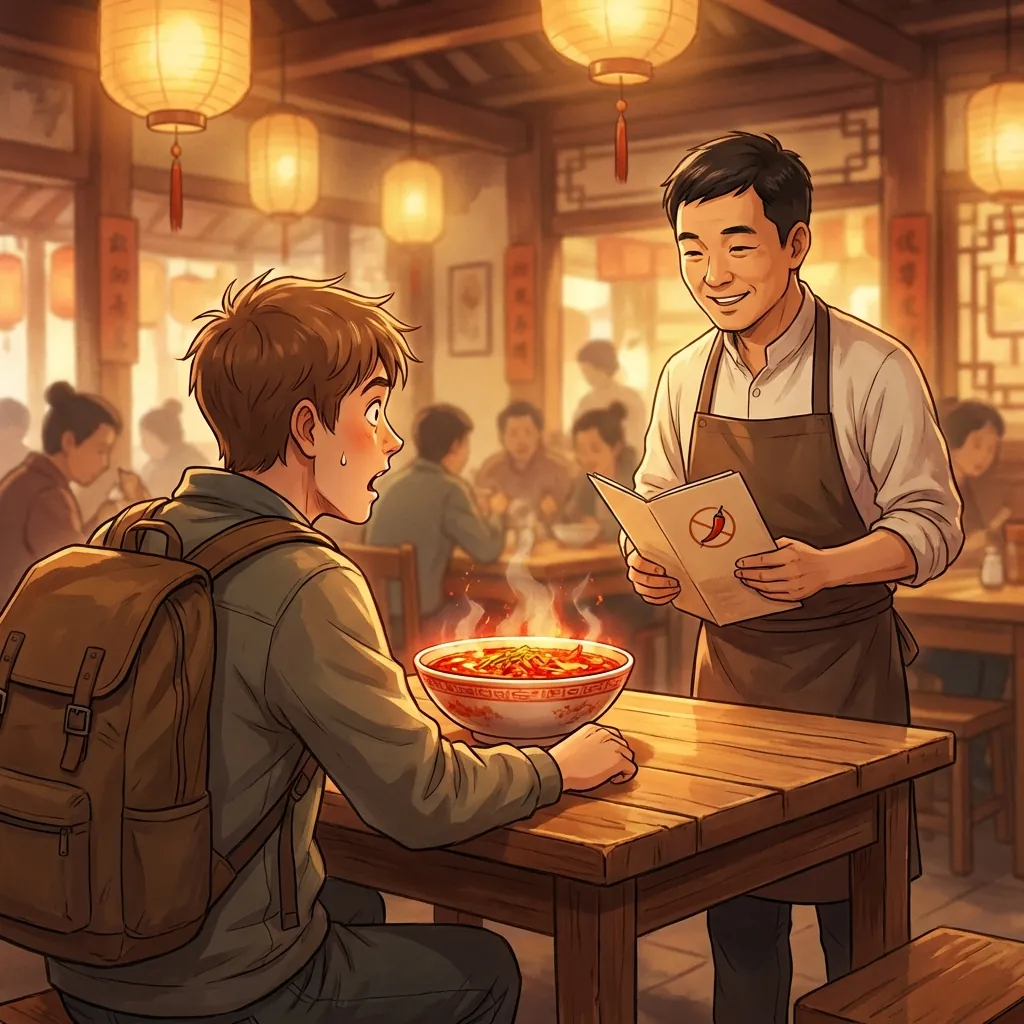
You did everything right. You opened your phrasebook, pointed at the characters for "Not Spicy," and confidently told the waiter: "Bu la."
Ten minutes later, you are weeping over a bowl of noodles that looks radioactive red, frantically chugging water while the staff looks on in confusion.
If you want to know how to order non spicy food in china effectively, you have to stop translating words literally and start understanding how a Chinese commercial kitchen actually works. There is a massive gap between what the dictionary says and what the chef hears.
Let’s fix your script so you don't end up needing a pharmacy run for stomach issues later tonight.
The Vocabulary Trap: Literal vs. Local Meanings
Most travelers learn two phrases for spice levels. Both of them are dangerous traps in the wrong region.
The "Wei La" (Micro Spice) Trap
Wei La (Micro Spice) is technically translated as "mild." In a Western context, mild means "no heat, just flavor."
In Sichuan, Hunan, or Guizhou cuisine, 微辣 (wēi là) does not mean mild. It means "The Minimum Viable Spice." It implies the chef will put less chili than usual, but the dish will still retain its spicy soul. If a dish is designed to be spicy, ordering it "Wei La" is like asking for a "dry thunderstorm"; you are still going to get wet.
The "Bu La" (Not Spicy) Misunderstanding
Bu La (Not Spicy) seems foolproof. 不 (bù) means "no." Logic dictates this means zero chili.
However, to a chef in a busy restaurant, "Bu La" is often interpreted as:
- "Don't add the handful of fresh chopped chilies on top."
- "Don't add the extra ladle of chili oil."
It rarely means "scrub the wok" or "make a separate sauce from scratch."
The Kitchen Reality: Why Your Order Was Ignored
To understand why your mouth is burning, you need to look at the logistics of a Chinese kitchen.
1. The Pre-Mixed Base
In many restaurants, the "sauce" isn't made fresh for every plate. The seasoning mix (often containing chili oil, peppercorns, and aromatics) is pre-prepped in a large vat. When you order 宫保鸡丁 (Kung Pao Chicken), the chef ladles in the pre-mixed sauce. They literally cannot remove the spice without cooking a different dish entirely.
2. Wok Residue
Chinese commercial burners are high-speed jet engines. Chefs cook fast. If the chef just cooked a Ma La (Numbing Spicy) dish and immediately tosses your greens into the same wok, your broccoli will pick up the spicy oil residue. This is sometimes called "Wok Hei" (breath of the wok), but in your case, it's "Wok Pain."
The Magic Words: How to Actually Get 0% Spice
If you have zero tolerance for heat or a medical reason to avoid it, you need stronger vocabulary. You need to move from "preference" words to "restriction" words.
Upgrade to "Mian La"
Instead of "Bu La," try using Mian La (Exempt Spice).
- Bu La: "I prefer it not spicy."
- Mian La: "Exempt this dish from spice entirely."
It sounds more technical and firm. It signals that chili is a contaminant to be avoided, not just a flavor you dislike.
The "Qing Dan" Signal
This is a cultural hack. If you tell the waiter you want to eat Qing Dan (Light/Bland), you are invoking a specific dietary concept. It means light, healthy, low oil, low salt, and no spice. It categorizes you as someone eating for health, and the kitchen respects that.
Ordering Example:
- You: 服务员,我要吃的清淡一点。一点辣椒都不要放。
- Pinyin: Fúwùyuán, wǒ yào chī de qīngdàn yīdiǎn. Yīdiǎn làjiāo dōu bùyào fàng.
- Meaning: Waiter, I need to eat lightly. Do not put even a little bit of chili.
Essential Vocabulary for the Spice-Averse
Here is your survival table. Memorize the "Safe" column.
| Simplified | Traditional | Pinyin | Meaning | Note |
|---|---|---|---|---|
| 免辣 | 免辣 | miǎn là | Exempt from spice | Use this for strict 0% spice. |
| 不辣 | 不辣 | bù là | Not spicy | Often fails in spicy regions. |
| 微辣 | 微辣 | wēi là | Micro spice | Usually still spicy. |
| 清汤 | 清湯 | qīng tāng | Clear soup | The safe word for hotpot/noodles. |
| 忌口 | 忌口 | jì kǒu | Dietary restriction | Use to signal allergies/strict rules. |
Safe Harbor: Dishes That Can't Be Spicy
Sometimes, the only way to win is to choose a battlefield where spice doesn't exist. If you are in a Sichuan restaurant and desperate, ignore the main menu and look for these structural safe havens:
- Tomato and Egg (西红柿炒鸡蛋): The national comfort food. Sweet, savory, never spicy.
- Steamed Egg (蒸蛋): A custard-like savory dish. Impossible to make spicy.
- Clear Broth Noodles (Qing Tang Noodles): Specifically request the clear soup base.
If you are traveling with a group and everyone wants spicy food, you can still survive. Just be careful with the vegetable dishes. Ironically, stir-fried cabbage is often one of the spiciest items on the table because dried chilies absorb into the leaves.
When in doubt, always ask: "Is this pre-mixed?" (这是调好的料吗? - Zhè shì tiáo hǎo de liào ma?). If they say yes, order something else.