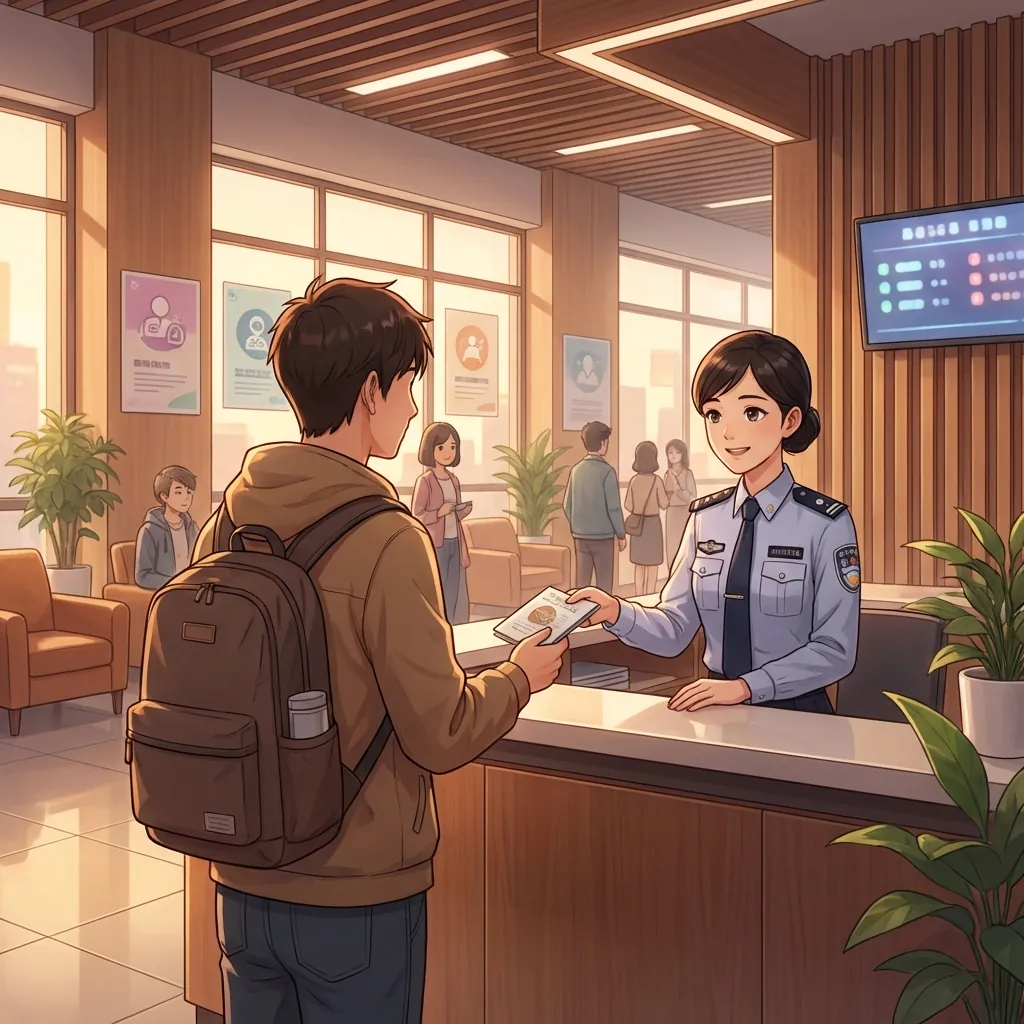
You have finally arrived. You have your visa, your Alipay is connected, and you have memorized how to order spicy chicken without accidentally ordering frog. But then, you encounter the bureaucratic reality facing every police registration china airbnb tourist. If you are staying in a private home rather than a hotel, this is not something you can ignore.
Let’s cut through the noise. Here is exactly how the system works, who needs to do it, and how to avoid an awkward conversation with immigration officers later.
The Golden Rule: The 24-Hour Clock
Chinese law requires all foreigners to register their temporary residence within 24 hours of arrival (72 hours in rural areas, but let's stick to 24 to be safe).
This process is called:
住宿登记
住宿登记Zhùsù dēngjì (Accommodation Registration)
Do you need to do this personally? That depends entirely on where you sleep.
Scenario A: The Hotel Traveler (Easy Mode)
If you are staying at a licensed hotel, hostel, or serviced apartment that accepts foreigners, you do not need to go to the police station.
The hotel staff does this for you. When they scan your passport at check-in, that data goes directly to the Public Security Bureau (PSB). This is why they stare at your passport page for five minutes while typing furiously.
Scenario B: The Airbnb or "Staying with a Friend" Traveler (Hard Mode)
If you are staying in a private apartment, an Airbnb (that isn't a managed serviced apartment), or on a friend's couch, you must register yourself.
There is no automatic system for private landlords. It is your responsibility (and your landlord's) to ensure this happens.
How to Register: The "Paichusuo" Run
To register, you need to go to the local police station serving your neighborhood. In Chinese, this is the:
派出所
派出所Pàichūsuǒ (Local Police Station)
Be warned: bureaucracy varies wildly by city. In Beijing, they might want your landlord present. In Shanghai, you might just scan a QR code on the wall.
What to Bring
Always bring originals and photocopies. If you don't have photocopies, the officer might point you to a convenience store down the street.
- Your Passport (original + copy of photo page & current visa/entry stamp).
- Lease Agreement or Property Deed (copy).
- Landlord's ID (copy).
- Landlord's Phone Number (write it down).
If you are staying with a friend, you need their property documents and ID. It can be a hassle, which is why I often recommend short-term travelers just book a hotel for the first few nights to get settled.
Essential Vocabulary for the Police Station
When you walk in, you don't need fluent Mandarin. You just need to state your purpose clearly.
| Simplified | Traditional | Pinyin | Meaning | Note |
|---|---|---|---|---|
| 登记 | 登記 | dēngjì | To register | The verb for the action |
| 境外人员 | 境外人員 | jìngwài rényuán | Foreign personnel | Formal term for foreigners |
| 临时住宿 | 臨時住宿 | línshí zhùsù | Temporary accommodation | What you are registering |
| 房东 | 房東 | fángdōng | Landlord | The person who owns your flat |
| 护照 | 護照 | hùzhào | Passport | Your ID |
Here is a simple dialogue script to get you started:
- You: 你好,我是来做住宿登记的。
- (Hello, I am here to do accommodation registration.)
- Officer: 带护照和合同了吗?
- (Did you bring your passport and contract?)
- You: 带了,这是所有的文件。
- (I brought them, here are all the documents.)
For more on navigating official forms, check out our guide on checking in and the registration form.
Can I Do It Online?
Maybe. This is the biggest recent improvement in Chinese compliance for tourists.
- Shanghai: Has a reliable "Self-Help Declaration System for Overseas Personnel" (WeChat mini-program).
- Shenzhen: Often allows WeChat registration.
- Beijing: Increasingly moving online, but enforcement varies by district.
If you are in a Tier 2 or Tier 3 city, assume you need to walk into the station physically. If you try to use an app and it fails, you have no proof of attempt. Physical paper is king.
What Happens If I Don't Do It?
If you forget, or if you think "I'm only here for three days, who cares?" then be careful.
While you won't get tackled by a SWAT team, you might face issues when you try to leave the country or extend your visa. The fine usually ranges from a warning up to 2,000 RMB.
More importantly, if you ever plan to apply for a longer-term residence permit or a work visa in the future, a record of "failure to register" can be a black mark on your file.
Summary
- Hotel: Relax. They do it for you.
- Airbnb/Friend: You must go to the Pàichūsuǒ within 24 hours.
- Documents: Passport, Lease, Landlord's ID.
- Don't panic: It is a routine administrative task, not an interrogation.
Just treat it like a quest in an RPG. Go to the station, hand over the items, get the stamped piece of paper (your "Registration Form of Temporary Residence"), and you're good to go.