We need to talk about one of the most persistent mistakes in Mandarin learning. It is a rite of passage. Almost everyone does it. But if you are searching for separable verbs Chinese list rules because you want to stop getting corrected on basic sentences, you are in the right place. It is time to fix this.
I am talking about this sentence:
❌ Wǒ yào jiànmiàn tā. (I want to meet him.)
我要见面他
To an English speaker's brain, this logic is flawless. Subject (I) + Verb (meet) + Object (him). Simple.
To a Chinese speaker, this sounds like: "I want to meet-face him."
It clunks. It breaks the rhythm. It is grammatically illegal. This happens because jiàn miàn (见面) is not a normal verb. It is a separable verb, or 离合词 (líhécí).
Let's fix this.
The Anatomy of a Separable Verb
The reason you cannot "jianmian" someone is hidden in the characters themselves.
Look closely at the word:
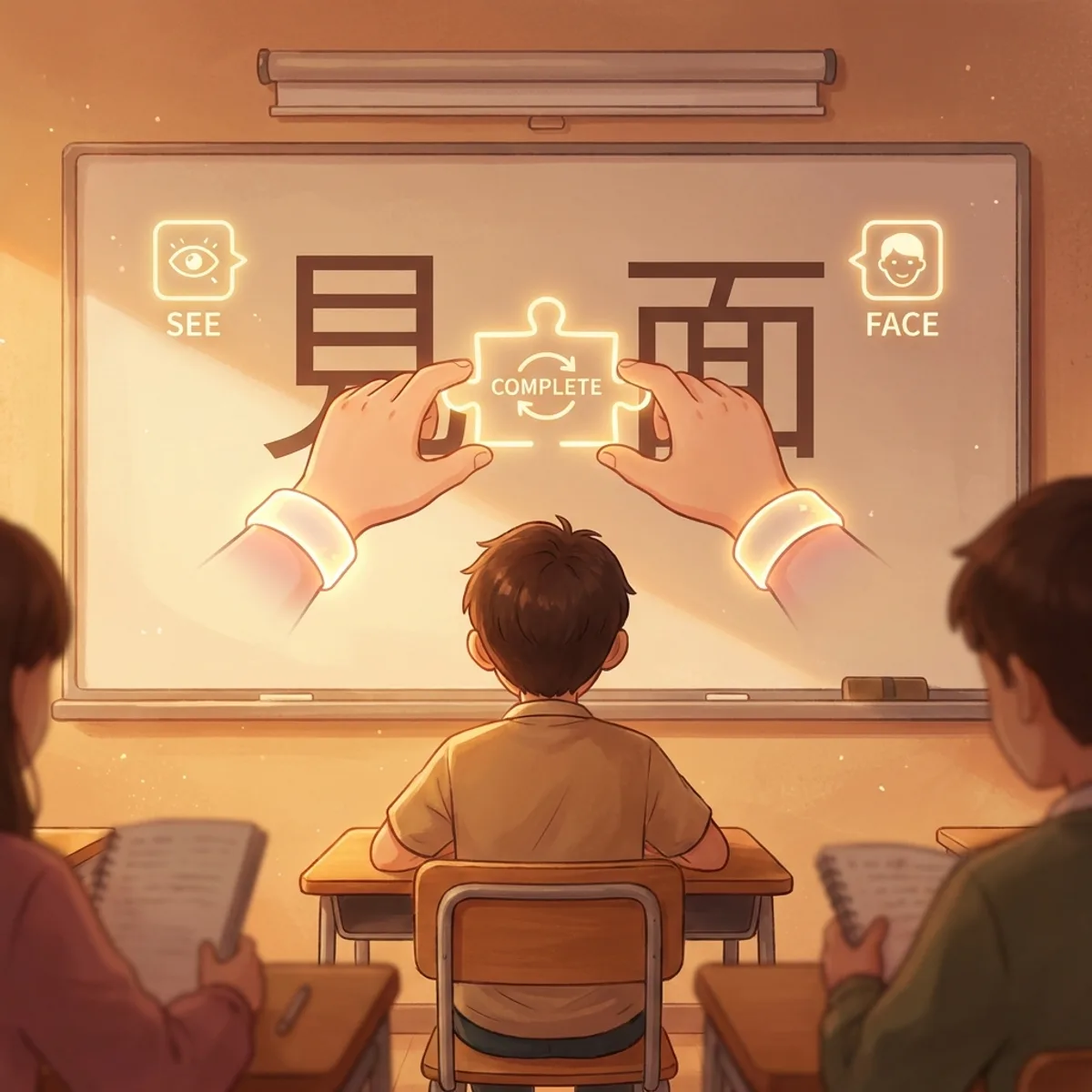
- Jiàn (见): To see (Verb)
- Miàn (面): Face (Noun/Object)
When you say jiànmiàn, you are not just saying "meet." You are literally saying "See Face." The word itself is a mini-sentence containing an action and a target.
This brings us to the One Object Rule.
The One Object Rule
In Chinese grammar, a verb usually can only handle one direct object at a time.
Since jiànmiàn is made of a verb (jiàn) that is already clutching an object (miàn), its hands are full. It cannot hold another object like "tā" (him) or "nǐ" (you).
If you say jiànmiàn tā, you are essentially trying to say:
"I see [face] [him]."
That syntax crashes. You have two nouns fighting for the object slot.
How to Fix It: The Preposition Strategy
So, if you cannot place the person after the verb, where do they go? You have to introduce them before the action using a preposition.
The most common structure involves using gēn (跟) or hé (和). Instead of "meeting him," you say "with him meet."
The Golden Structure:
Subject + Gēn (Person) + Jiàn Miàn
Examples:
✅ Wǒ yào gēn tā jiànmiàn.
我要跟他见面。(I want to meet with him.)
✅ Míngtiān wǒ gēn péngyou jiànmiàn.
明天我跟朋友见面。(Tomorrow I meet with a friend.)
This logic applies to many interactions. If you have read our guide on stop using he to connect sentences, you know that placement of "who you are doing things with" is critical in Mandarin syntax.
Why They Are Called "Separable"
They are not just called "Verb-Object Compounds"; they are called separable verbs because you can literally tear them apart and stuff other words inside.
This is the cool part. Once you realize jiàn is the verb and miàn is the noun, you can put grammatical particles between them.
Inserting "Le" (The Past/Completion)
Beginners often ask, "Where do I put the le?" If you put it at the end (jiànmiàn le), it's acceptable in casual speech, but strictly speaking, the aspect particle le usually wants to hug the verb immediately.
✅ Wǒmen jiàn le ge miàn.
我们见了个面。(We met up.) Lit: We saw [le] a face.
You may also hear the shorter jiàn le miàn. In everyday speech, adding ge makes the phrase feel natural and complete.
See Is 'Le' Past Tense? for more on why le behaves this way.
Inserting Duration and Frequency
If you want to say "We met once," you don't put "once" at the end. You put it in the middle.
✅ Wǒmen jiàn guo yī cì miàn.
我们见过一次面。(We have met once.) Lit: We see [aspect] one time face.
The Usual Suspects: A List of Common Traps
Jiànmiàn is just the tip of the iceberg. Here is a table of common separable verbs that trip up learners, along with the correct usage logic.
| Simplified | Traditional | Pinyin | Meaning | Note |
|---|---|---|---|---|
| 见面 | 見面 | jiàn miàn | To meet | Logic: See + Face. Don't say jiànmiàn tā. Use gēn tā jiànmiàn. |
| 帮忙 | 幫忙 | bāng máng | To help | Logic: Help + Busy/Favor. Don't say bāngmáng wǒ. Use bāng wǒ or bāng wǒ de máng. |
| 结婚 | 結婚 | jié hūn | To marry | Logic: Knot + Marriage. Don't say jiéhūn tā. Use gēn tā jiéhūn. |
| 洗澡 | 洗澡 | xǐ zǎo | To shower | Logic: Wash + Bath. Don't say xǐzǎo gǒu for "wash the dog." Use gěi gǒu xǐzǎo. |
| 生气 | 生氣 | shēng qì | To get angry | Logic: Grow + Gas/Anger. Don't say shēngqì tā. Use shēng tā de qì. |
A Special Note on Bāngmáng (Help)
Bāngmáng is tricky. You will often hear students say "Bāngmáng wǒ" (Help me). This is wrong.
- Bāng (帮) = To help (Verb)
- Máng (忙) = Busyness/Favor (Noun)
If you want to help someone, just use the verb part:
✅ Bāng wǒ!
帮我!(Help me!)
Or split it:
✅ Nǐ néng bāng wǒ ge máng ma?
你能帮我个忙吗?(Can you do me a favor?)
Quick Summary
Whenever you learn a two-character verb in Chinese, ask yourself: Is this actually a Verb + Noun compound?
- If the second character looks like a noun (Face, Book, Rice, Marriage), it's probably separable.
- If it is separable, do not put a person after it.
- Use Gēn (with) or Gěi (for/to) to introduce the person before the verb.
Mastering this stops you from sounding like you are translating English word-for-word and makes your sentence flow sound authentically Chinese.